Peoples Peace Treaty: Documents from and about the webinars


Gathering marks 50 years of Vietnam - US People’s Peace Treaty

The Vietnam Union of Friendship Organisations (VUFO)’s Vietnam - US Society (VUS) and the US’s Vietnam Peace Commemoration Committee (VPCC) held a friendship meeting on April 20 to mark the 50th anniversary of the People’s Peace Treaty between Vietnam and the US.

VNA Tuesday, April 20, 2021 18:42

Gathering marks 50 years of Vietnam - US People’s Peace Treaty hinh anh 1

At the event (Photo: VNA)

Hanoi (VNA) - The Vietnam Union of Friendship Organisations (VUFO)’s Vietnam - US Society (VUS) and the US’s Vietnam Peace Commemoration Committee (VPCC) held a friendship meeting on April 20 to mark the 50th anniversary of the People’s Peace Treaty between Vietnam and the US.

Held via video conference, the meeting was co-chaired by John McAuliff from the VPCC and VUS General Secretary Bui Van Nghi.

The meeting aimed to share information on an outstanding event among student movements against the war both in Vietnam and in the US, and the role of the people’s movements during important historic periods.

The People’s Peace Treaty was signed by representatives of four US and Vietnamese student organisations in 1971, reflecting their common aspiration for peace and raising a strong voice to end the war waged by the US in Vietnam.

It also contributed to encouraging anti-war movements by American students and peace lovers and pushing Vietnam’s fight for national independence.

Speaking at the event, VUFO President Nguyen Phuong Nga expressed her hope that the friendship between the two peoples, especially the younger generations, will grow further, contributing to promoting the comprehensive partnership between the two countries.

Pham Van Chuong, Chairman of the Vietnam Committee for Asian - African - Latin America Solidarity and Cooperation, Vice Chairman of the Vietnam Peace and Development Foundation, and Vice Chairman of the Vietnam Peace Committee, affirmed that the anti-war movement in the US and the signing of the treaty were unprecedented in history, demonstrating the aspiration for peace among progressive Americans and others around the world.

  https://en.vietnamplus.vn/Utilities/Print.aspx?contentid=200404


PPT 50th Anniversary Webinar

20 April 2021


Remarks from Phạm Văn Chương


1. Today, we Vietnamese and Americans are commemorating the 50th anniversary of the People’s Peace Treaty. I am thinking about the late Đỗ Văn Hiền and David Ifshin, two of the four Treaty signers. They are no longer with us, but I believe up there they could be happy to see that down here we are following in their footsteps.


2. The events in Saigon and Hanoi in December 1970 were not the first meetings between representatives of people’s organizations from the United States and the two parts of Vietnam in joint efforts towards an end to the war and the return of peace. For instance, there had been such meetings in Jakarta, Indonesia, in 1965; Paris, France, in 1967; Bratislava, Slovakia now, also in 1967; and Niagara Falls, Canada, in 1969. But, all these were held outside Vietnam, while the PPT events took place right on Vietnamese soil, where the war was raging, and particularly in Saigon, from where the US Military Command was directing the war day in day out.

Moreover, while joining the other events were 3 groups – American, Democratic Republic of Vietnam and NFL (National Front for Liberation) / PRG (Provisional Revolutionary Government), joining the 1970 events were 4 groups – the above-mentioned three plus the Saigon-based student movement with its newly elected President Huỳnh Tấn Mẫm, part of the urban people’s movements emerging in many cities of South Vietnam in the wake of the 1968 Tết Offensive. Thus, Vietnamese participation in the 1970 events was, in a sense, more comprehensive.


3. Half a century after the PPT events, relations between Vietnam and the United States, especially between the people of the two countries, have gone a long way. Yet, there remains much that could and should be done, and I think both of us Vietnamese and Americans are to uphold the spirit of the 1970s and make further contributions in the new situation.


4, Following the 1970 PPT events, the Paris Agreements were signed in 1973, and peace was actually materialized in 1975. Forty six years have elapsed since, but multiple consequences of the war still remain. There are millions of Vietnamese victims of the dioxin-laden Agent Orange who need support. There are thousands and thousands of landmines and other Unexploded Ordnance (UXO) that need removal. And there is the peace that all of us made contributions for its return that is still not fully free from threats. All this, I believe, requires of us veterans further efforts, to be joined by others from younger generations.

Thank you./.


On the 50th anniversary of the People’s Peace Treaty

between US and Vietnamese students


by HUYNH TAN MAM


As you know, peace and patriotism have been part of the one thousand years of Vietnamese tradition, that is what drives us to fight against foreign invasion.

This tradition has won the support of all Vietnamese, when Geneva Agreement of 1954 was signed to end the war with French colonialists. However when the US entered and supported the government of Ngo Dinh Diem and successive regimes of military commandants that they created to to dishonour the Agreement, not respecting the self determination of the Vietnamese people, its military intervention, waging war and death in VN contradicted the deepest aspirations of our people, hence we all stood to fight for our independence.

The historical circumstances

Following the general attack of 1968 by the armies of North VN and the NLF right into Saigon, the capital of South Viet Nam, the government of SVN decreed a total draft in South VN, all young men of 18 years up have to enlist to serve in the army, university students will have military training on campus, to form the armed forces to protect the capital.

That led to a revolt from the Student Union who quickly called upon all students unions througout South VN, Hue, Can Tho and all High School students, to unite and demonstrate, refusing militarization and armed training. The Student Union allied with the community organizations also to create a Committee to defend people’s rights for self determination.

This was an opportunity for the government to brutally repress the opposing movement. Subsequently, in 1969 many student leaders, including myself who as elected president of Saigon Student Union. We was arrested, tortured and imprisoned.

Students accross South VN demonstrated even more fiercely, asking for the withdrawal of American forces from Viet Nam, and statements and calls were sent via the press to many international organisations in the US, France, Japan, Canada, Holland around the world to ask for support. Students were immediately suspected and banned from any traveling out of the country where they can meet with students of the world to create a stronger movement.

In front of such brutal repression from the Saigon government, US students applied to come and see the reality and join forces with VNese students to call for an end of the war were also banned from coming. But the government did release us Mam and the student leaders in April 1970.

US students were officially banned from entrance to VN, so they had to go to through tourist visas to plan to come to VN via Laos, to overcome the barriers.

On June 30, 1970 we had secretly asked the patriarch Thiên Hoa of An Quang pagoda to host this international student conference, while we organized another at the School of Agriculture. Charles Palmer with his student delegation came, and together with us led a demonstration to the American Embassy that drew thousands of people on the street with the paper doves as symbols of peace and red coffins as the symbols of death and destruction caused by the war. The demonstration was repressed with firehoses, tear gas and Charles Palmer and his US delegation was expelled from Viet Nam.

Following US student unions presidents David Ifshin and E. Tebankin  continue to send support to us via the press.

December 1-1970 Students of South Vn declaring on peace in VN

Students of Saigon, Van Hạnh, Hue, Can Tho, Dalat and High School Student Union got together to draft a peace statement with 4 points: the goverment of South VN has to be self determined by the people, US and allied forces need to withdraw from VN

December 17-1970 Peace declaration between  US, Hanoi and NLF students in VN in Hanoi

An American delegation of 15 representatives led by David Ifshin signed a statement of peace, with Do Van Hien, president of Hanoi Student Union and Nguyen thi Chau, president of NLF student. The main point was immediate withdrawal of US and allied forces from VN, end of support to Nguyen van Thieu’s government, and respect of independence, peace and neutralism of Lao and Kampuchia.

August 2-1971 Peace Treaty signed in Saigon between representatives of South VN Student Union and  US delegation

An American delegation led by David Dull, Scientist George Wall, 1967 Nobel Prize recipient in Physics and Medicine, with delegates of Saigon, Van Hanh, Can Tho, Hue and High School Student Union signed together a statement to end the war and bring peace to VN.

Students who supported the South VN governement in protest

Some students who supported the government of South VN declared that this is indeed a treaty orchestrated, manipulated by the Communist. The government immediately carried out a whole raid to arrest all students activists, in order stem out, extinguish the movement before the Paris Peace Treaty. Hundred of us were arrested as a result, interrogated and imprisoned end of 1971.


1970-1971: 

Nixon, Discord, and the US Withdrawal from Vietnam

Texas Tech Conference: April 9-10, 2021

The People’s Peace Treaty


Doug Hostetter


The People’s Peace Treaty was the only joint antiwar activity which was done in collaboration between the US peace movement, the South Vietnamese peace movent and the friendship and solidarity movement in North Vietnam.


            1970-1971 were difficult years for the War in Vietnam and years of growing strength in the antiwar movement in the US.  There were Vietnam Moritorium marches across the country and around the world in October, 1969, and the in November, 500,000 people participated in the Moratorium March on Washington, the largest antiwar demonstration in the history of the US.  Despite the unprecedented numbers of demonstrators, and massive response of the police the political response of the Nixon administration was to dig in, and expand the war into Cambodia in the spring of 1970. The invasion of Cambodia resulted in major student demonstrations and sit ins in most US colleges and universities which were further intensified by the killing of students in Jackson State and Kent State Universities by National Guard soldiers.  Many US colleges and universities were closed down by demonstrations, teach-ins or student occupations, and numerous schools had to close for the semester without giving final examinations that semester. 


The US peace movement by this time had also reached out to the Vietnamese peace movement in South Vietnam and to the friendship and solidarity movement in North Vietnam.  By the spring of 1970 American peace activist who had visited with student activist in Saigon came back with a proposal from the Saigon Student Union, that students in Saigon, the US and Hanoi should cooperate to develop a People’s Peace Treaty that would point a viable way to end the ongoing deadly war.  The proposal was accepted, and at the August 1970 Congress of the US National Student Association (NSA) at Macalester College in St. Paul, Minnesota, it was decided NSA world send a delegation of students from US colleges and universities to meet with students from South (Republic of Vietnam, RVN) and students from North Vietnam (DRVN) to develop the treaty.  The NSA committed itself to recruiting a geographically, racially and gender diverse group of student body presidents and campus newspaper editors for the delegation which was to travel to South and North Vietnam in December.  On November 1st, Larry Magid, a NSA staff member from the national office in Washington, flew to Paris with a letter from Rennie Davis (a prominent antiwar activist and one of the members of the Chicago 7 trial) to Mme Binh.  The letter introduced Larry Magid, and asked for Mme Binh’s support of this effort.  The letter stated in part, “When I was last in Paris, I discussed with you an idea of a citizen’s “peace treaty,” a kind of joint communique signed by Vietnamese and Americans outlining the correct steps for ending the war. The concept of a citizen’s peace treaty is gaining enormous support in the United States.”


The NSA recruited 14 person delegation of student body presidents and campus newspaper editors from colleges from across the US for the trip to Saigon and Hanoi.  Initially, the US State Department was supportive of the effort and assured visas would be issued by South Vietnam so that the group could meet with students from the Saigon Student Union.  The supportive response from the US Government ment quickly cooled when the State Depart learned that North Vietnamese had agreed to issue visas for the delegation to visit students in the North.


I was not a part of the original 14 person NSA delegation, but had been recruited as a 15th member because I was a graduate student and fluent in Vietnamese.  I was a conscientious objector, who had chosen to do my alternative service in Vietnam, in the middle of the war zone, working for the Mennonite Central Committee doing literacy work with refugee children who had lost their schools due to the war.  By the time I was recruited, NSA realized that the State Department no longer supported the trip, so my name was left off delegation lists given to the press.  I left for Saigon a week before the official NSA delegation, and was able to enter South Vietnam without problems, while the listed NSA delegats, were all denied visas when they tried to enter Saigon.

            I applied for a visa as a Sociologist (which I was) on vacation (which I was), and had no difficulties at immigration at the Tan Son Nhat Airport in Saigon.  I was warmly welcomed by Huynh Tan Mam, President of the Saigon Student Union, and his colleagues at the Student Union.  They had known that the US NSA was coming, and they were eager to work with us in implementing a People’s Peace Treaty.  We had only cordial meetings in their small Student Union office, far from the campus, in one of the poorer sections of town.  I also took the opportunity to visit Mennonite friends in Saigon, and return to Tam Ky in Central Vietnam, to visit with Vietnamese friends and colleagues from the years I had worked there with the Mennonite Central Committee.  When I returned to Saigon, Huynh Tan Mam indicated that we needed to hold a press conference, before I left to announce the People’s Peace Treaty.  I remember responding, “Sure, we could hold a press conference, but if we did, I would likely disappear after entering customs at the Saigon Airport to fly to Bangkok the following day.”  “But I know the US and Saigon governments,” Huynh Tan Mam said, “if we don’t hold a press conference with you here, they will deny that you were ever here, or that the Saigon Student Union was involved in negotiating this treaty.  They will say that the People’s Peace Treaty was completely drafted and signed only in Hanoi.”  After some discussion, it was decided that we would hold a secret press conference before I left, inviting only one trusted Vietnamese and one international journalist who would both agree to hold the story until I had cleared customs and left Vietnam.  I don’t recall who the Vietnamese journalist was, but I do remember that the students invited Dan Sotherland from the Christian Science Monitor as a trustworthy US journalist.  

             The secret press conference went well, and I had no trouble passing customs at Tan Son Nuit Airport the next day on my way to Bangkok.  The flight to Bangkok and connecting flight to Vientiane, Laos went smoothly.  I had a few day layover to get my visa to Hanoi and catch the once a week Areoflot flight from Moscow that stopped in Vientiane on its way to Hanoi.  The one thing that we had not considered, was that the CIA would pick up the article from the Vietnamese press.  When I landed in Vientiane I dropped my luggage at my hotel, and headed for the bar in the Hotel Constellation, the press watering hole in Vientiane, where I had planned to meet a friend from Dispatch News Service.  He saw me as soon as a I entered, and rushed over to tell me that the Lao Police had been at the bar an hour earlier, and had gone up to the bar and approached one of the members of our delegation who had been turned away in Saigon, and was waiting to travel the next day with me to Hanoi, and asked him if he was Doug Hostetter.  And when he had said, “no,” they asked to prove it with his passport.  “They are looking for you, so if you are carrying anything that you would not like them to find, I would recommend that you get rid of it right away.”  I quickly returned to the hotel and retrieved the signed copy of the People’s Peace Treaty, and brought it back and gave it to my journalist friend asking him to keep it secure and give it to me the following morning before my flight to Hanoi.  He agreed, we had a beer  and a quick catch up before I returned to my hotel.  I wasn’t back in my room more than 15 minutes before there was a loud knock on the door and four Lao police were asking to enter and search my luggage for “illegal document.”  It was a bit awkward for everyone.  I had removed only the People’s Peace Treaty, but had left all of my documents about the various governmental peace proposals, background materials for the trip and articles about Vietnam and the peace negotiations taking place in Paris.   My materials were all in English and Vietnamese, and the four Lao Police spoke only broken English, no Vietnamese, and did not know exactly what they were looking for.  They explained that we would need to wait for English and Vietnamese translators to help them go over the materials in my briefcase, but they could lock the materials in their safe, and we could all go out to dinner while we awaited the translators.  I remember it was a sumptuous dinner in Vientiane’s best restaurant.  When we returned to the locked safe with my briefcase, I noticed that the materials in the briefcase were not in the order in which we had left them, but decided not to mention it.  Among the suspicious documents that they selected to take for further inspection were:  The DRVN (North Vietnam) Peace Proposal, the Provisional Revolutionary Government (the government of the South Vietnamese National Liberation Front) Peace Proposal, (even they knew that the US Government Peace Proposal was not worth further study), military post cards that I had bought in the PX in Saigon, and my copy of Eldridge Cleaver’s, Soul on Ice.  After a complete search of my room (which included taking apart my ballpoint pen to look for a secret message inside), the police Lt. Col. who was in charge of the investigation stood up and announced proudly in broken English, “We search just like they do in the United States, I was trained in Fort Bragg!”

            The next day I was met at the airport by my journalist friend who returned the signed copy of the People’s Peace Treaty to me shortly before the flight to Hanoi.  I North Vietnam I was warmly welcomed by the other 14 members of the People’s Peace Treaty delegation.  Part of the group had traveled directly to Hanoi, but the members of the delegation, who had tried to travel to South Vietnam, were refused entry at the Saigon Airport, and placed on the next flight to Bangkok.  They had then flown to Vientiane and Hanoi, arriving there a week before me.  We were also welcomed by the “Viet – My,” the Vietnamese American Friendship Organization which had been welcoming US peace movement activist in Hanoi since the early 1960’s, and the Vietnam National Student Union (North Vietnamese Student Union).  The Northern students were very interested in seeing the South Vietnamese draft Treaty, and asked many questions about the Saigon Student Union, and the peace movement in the Vietnamese cities in the South.  The draft treaty from the North was almost identical to that of the South, except that the North had wanted to include a section which required the US to also leave Laos and Cambodia.  I had missed a week of activities for our delegation while I had been in South Vietnam, but was there for a visit with the War Crimes Committee that introduced us to some of the weapons used by the US military in Vietnam, the cluster bombs in which a ‘mother bomb” releasee hundreds of small antipersonnel bombs which exploded on impact spewing small metal fragments, or even more troubling, hard plastics that can penetrate the body, but do not register on X-rays.  We were also introduced to the new, improved napalm, which burns even hotter than the original napalm.  We also learned about Agent Orange, the herbicide, contaminated with dioxin (one of the toxic substances known to man) sprayed widely in South Vietnam by the US Air Force to defoliate trees to deprive  guerrillas of cover.   We visited the Banci Hospital which had a section devoted to the care of people from the South who had been exposed to Agent Orange.  We met with Dr. Nguyen Xuan Huyen, the North Vietnamese Dr. who dedicated his life to treating the victims of Agent Orange.  He introduced us to three of his patients all three were from villages in the South, and two of the three had been sprayed directly when they were pregnant, and the third was never sprayed directly, but lived for 4 years in an area that had been heavily sprayed.  All three women had seriously deformed children, even though none of them had a history of deformities in their families, and one of the women had had two healthy, normal children before the war started.  Dr. Huyen gave me slides of chromosomes of several of his patients which indicated that Agent Orange/Dioxin not only caused deformities in children of mothers who had been exposed, but also deformed the chromosomes to the patient which meant that the deformity would be passed on to the next generation.  When I returned to New York, I gave the slides a graduate student friend of mine who shared the slides with his professors in biochemistry at Columbia University.  He reported that his professors had looked at the slides, and had agreed that it would be disastrous if it were documented that Agent Orange/Dioxin was mutagenic, but that making slides of chromosomes is a very difficult technical process, and that Western scientists would never accept as valid any slides of chromosomes done in North Vietnam.

            We also had time to visit the scenic Ha Long Bay, off of the eastern coast where clusters of small mountains emerge from the bay, almost like the humps of dragons swimming in the sea, visit the Lake of the Returned Sword in the center of Hanoi, where several years later US pilots would be rescued after parachuting from their wounded B-52’s during Nixon’s Christmas Bombing of 1972.  Several times during our visit, we had the amazing experience of being rushed by our Vietnamese hosts into a nearby bomb shelter as American bombers passed over head on bombing raids, which fortunately were always targeting other locations.

            After our formal signing of the People’s Peace Treaty with the head of the US NSA, the head of the Vietnam National Student Union (North Vietnamese Student Union), and a young woman who was the head of the South Vietnamese Liberation Student Union, we were all invited to meet with the North Vietnamese Prime Minister, Phan Van Dong.  The Prime Minister congratulated us for our efforts, warned us that we must have courage, and perhaps some of us would go to prison for our efforts for the People’s Peace Treaty.  (Actually, Huynh Tan Mam, the President of the Saigon Student Union was subsequently arrested by the Saigon government and spent two years in Cu Chi prison in Saigon.)  He ended our time together saying, “We are all human, we have the same feelings. . . There is no longer space that separates us, satellites travel around the world in 90 minutes.  Why can’t we all be friends?”

             We were worried about how the US government would react to our announcement that we had signed a People’s Peace Treaty between students in the US, Students in Saigon, students in Hanoi, and even students who were living in the parts of South Vietnam that were controlled by the National Liberation Front of South Vietnam.  We decided that the safest thing would be for us to come home from Vietnam via the Aeroflot flight from Hanoi to Moscow (a 23 hour flight on a Russian turpo-prop, with stops in the capitals of many of the Republics of the USSR along the way).  From Moscow we would fly to Paris where we would hold a press conference the following day, announcing to the world that we had a peace treaty between the US and the Vietnam that had been negotiated by US and North and South Vietnamese students which could serve as a model for our governments to make peace.   

            As students we were proud that we had successfully accomplished our task, despite considerable efforts of the US and South Vietnamese government to block our efforts.  When we arrived in Paris we were met by several experienced organizers who had helped to prepare the way, and guide the effort along the way.  Reny Davis and John Froins, both made famous by the Trial of the Chicago 7 for their protest of the Democratic National Convention in Chicago in 1968.  The “movement heavies” were not impressed with our treaty, and immediately realized that the treaty wording which we had come back with was full of anti-imperialist rhetoric, which likely felt good to all of us students, but which would make the “treaty” unusable for the broad organizing effort that they had envisioned for the People’s Peace Treaty.  I remember that they spent the entire night, revising the treaty in a way that kept all of our original political points, but phrased it in language which they knew would enable the treaty to be an document accessible to the broad US audience, and enable it to become the broad organizing tool which could enable average Americans to realize that there was a viable option for peace with Vietnam and ending the Vietnam War.  Once they had settled on suitable language for the treaty, they then had to spend the rest of the evening meeting with diplomats from the DRVN (North Vietnamese) Embassy and from the PRG Embassy (Government of the National Liberation Front in South Vietnam) to make sure that those governments understood why we had decided that the wording needed to change, and that they felt comfortable that the revised wording did not change the underlying meaning or politics of the document we had originally drafted.  By morning agreement had been reached, and we went ahead and presented to the world press the revised wording as the People’s Peace Treaty.

            The timing was perfect, as US colleges and universities were teaming with students who were worried that they would soon graduate and be drafted into a deadly war that they felt was wrong, and a cause for which they certainly did not wish to give their lives.  By March there were People’s Peace Treaty offices in 12 cities, student body presidents in hundreds of US colleges and Universities has signed the treaty, and in the 10 schools where there had been a campus-wide referendum, it had passed in every one.

            The treaty also quickly moved beyond the National Student Association and US campuses with major antiwar organizations across the country endorsing the treaty and using it with their own constituency.  Among the organizations which endorsed and used the treaty were:  American Friends Service Committee, Chicago Peace Council, Clergy and Layman Concerned about Vietnam, Los Ageneles Peace Action Council, National Lawyers Guild, New University Conference, Peoples Coalition for Peace and Justice, Women’s International League for Peace and Freedom and Women Strike for Peace.

            Prominent members of the US cultural, academic and religious community endorsed the People’s Peace Treaty and allowed their names to be used to further publicize the treaty. 

            African American leaders like Mrs. Martin Luther King, Jr, Rev. Ralph Abernathy, Congressman Herman Badillo. Julian Bond, Congressman John Conyers, Ericka Higgins and Bobbie Seale. 

            Religious leaders like Rabbi Belfour Brickner, Rev. Daniel and Phillip Berrigan, Malcolm Boyd, William Sloane Coffin, Robert MacAfee Brown, Bishop Robert DeWitt, Bishop William Davidson, Bishop Paul Moore, Bishop Tomas Gunbleton, Richard McSoreley, Sister Elizabeth McAlister, Father James Groppi, Sister Margaret Traxler and Sister Joques Egan. 

            Cultural figures like Judy Collins, Jules Feiffer, Jane Fonda, Betty Friedan, Mitchell Goodman, Cleve Gray, Francine du Plessix Gray, Dick Gregory, Julie Harris, Rock Hudson, Jennifer Jones, Denise Levertov, Robert Jay Lifton, Senator Eugene McCarthy, Kate Millett, Grace Paley, Gloria Steinem,  I.F. Stone, Paul Sweezy, Bert Schneider, Benjamin Spock, Studs Terkel and Dalton Trumbo.

            Prominent academics like Noam Chomsky, Richard Falk, Kenneth Kenniston, Salvatore Luria, Ashley Montagu, Eric Segal and George Wald.

            And of course, there were the leaders of the antiwar movement including Timothy Butz, Kay Camp, Rennie Davis, Dave Dellinger, Daniel Ellsberg, Richard Fernandez,  David Hawk, Tom Hayden, Abbie Hoffman, Al Hubbard, William Kunstler, Stewart Meacham, Sidney Peck, Amy Swerdlow, Cora Weiss and George Wiley. 

There were also the union activists including Abe Feinglass, Henry Foner, Mo Foner and Patrick Gorman.

By the end of April, US Representatives Abzug, Badillo, Chishom, Clay, Conyers, Dellums, Mitchell and Scheuer had introduced into the US Congress a Concurrent Resolution:


“Expressing the sense of the Congress with respect to the People’s Peace Treaty

Whereas the efforts to attain a negotiated settlement of the Indochina conflict at 

the Paris Peace Talks have been unsuccessful for many months; and

 Whereas a direct equitable solution to the war is now possible; and

 Whereas the principles of the People’s Peace Treaty for the basis for a just and honorable end to the war in Indochina;

 Now therefore, be it

 Resolved by the House of Representatives (the Senate concurring),

That it is the sense of the Congress that the People’s Peace Treaty embodies the legitimate aspirations of the American and Vietnamese peoples for an enduring and just peace in Indochina.”       4/29/71


On January 27, 1973, just over two years after the People’s Peace Treaty was negotiated, Henry Kissinger and Le Duc Tho signed the Paris Peace Accords in Paris which formally ended the US direct involvement in the Vietnam War.  They were both awarded the Nobel Peace Prize in 1973, although Le Duc Tho declined to accept it. The Paris Peace Accords, like the People’s Peace Treaty called for an immediate ceasefire, withdrawl of US troops from Vietnam, the release of prisoners of war, and for the Vietnamese to form a government without US interference. 


When the People’s Peace Treaty was signed at the end of December 1970, there were about 44,000 Americans listed as killed or missing in action in Vietnam.  Today there are just over 58,000 names of Americans listed on the Vietnam Memorial Wall.  Had the US government accepted the People’s Peace Treaty in early 1971, 14,000 Americans and hundredcs of thousands of Vietnamese would still be alive today.


Helena Sheehan Writes About Mayday


Mayday 1971


An excerpt from book Navigating the Zeitgeist by Helena Sheehan

The national anti-war movement was undergoing major shifts and splits at this time. In January 1971 Joe Miller and I attended the meeting of the National Coalition Against War, Racism and Repression (NCAWRR) in January 1971 in Chicago. This soon became the People’s Coalition for Peace and Justice (PCPJ). There was another national anti-war coalition called the National Peace Action Coalition (NPAC). Both of these were descended from previous national anti-war coalitions, resulting from splits in the National Mobilisation Committee to End the War in Vietnam (the Mobe), which organised mass anti-war demonstrations in 1967.  The great divide was single issue (end the war) and single tactic (mass march) versus multi-issue (connecting the war to the system responsible for racism, poverty, repression) and multi-tactic (mass marches plus a whole variety of other forms of protest). NPAC was dominated by the trotskyist Socialist Workers Party and wanted to keep bringing out the maximum number of people in national demonstrations against the war. The NCAWRR was sometimes called the ‘coalition against everything’. PCPJ wanted not only to broaden the focus, but to engage in more varied and more militant tactics to build pressure against the war. It wanted to go beyond repetition of the passive mega-march to more active tactics that would up the ante against the government. It was a coalition of many anti-war, anti-poverty, anti-racist groups, both old and new left. NPAC and PCPJ continued to negotiate to form a united front at least on some activities.

The January 1971 meeting was a new experience for me. It was the first time I met a number of national figures, such as Dave Dellinger and Rennie Davis, whom I had only admired from a distance. There were many tensions between different forces and references to past events that I didn’t quite understand. I was determined to get up to speed, though, and more experienced figures, not least Joe Miller, put me in the picture. We agreed on a spring offensive that would centre on the people’s peace treaty, include a people’s lobby in DC in April and culminate in a series of non-violent but militant protests in DC in May. The degree of militancy was a point of tension. Dave Dellinger and Rennie Davis were arguing for mass civil disobedience that would threaten to stop the government if the government didn’t stop the war.

This line was strengthened after a conference in Ann Arbor, which I also attended, after a long drive in stormy weather. This was followed later in February by a meeting of a May task force in DC in late-February. By this time I was speaking up, joining in the fray and taking positions in debates. I was really flattered when Dave Dellinger spoke and cited me as an example of the sort of leadership that needed to be exercised. I spoke with him many times during these months, including during several inter-city train journeys, and I respected him enormously. In March I flew to Chicago again for a meeting of the PCPJ national co-ordinating committee and took the train to New York for another task force meeting. I also flew to Bloomington in early April for an NUC conference, where I spoke to build support for actions in late April and early May in DC. I met with Science for the People while there and we explored a proposal to set up an international people’s university.

After each of these national meetings, I reported back to Philadelphia, where we were planning our own spring offensive co-ordinated with the national one. We opened up a PCPJ office in Philadelphia. I spoke at a number of rallies, visited many groups and campuses and organised various activities that would mobilise support for the people’s peace treaty and organise our participation in various actions in DC in April and May. We showed a film called Time Is Running Out, an emotionally powerful film about the struggle of the Vietnamese people and the necessity of our spring offensive, featuring Rennie Davis and Judy Collins. At least we did so until Peter unwittingly handed our copy over to someone, probably an FBI agent, and it disappeared.

Within PCPJ there emerged a May Day collective, spearheaded by Rennie Davis and Mike Lerner, which I identified with more and more. I was not comfortable with the banner of being a student-youth coalition though. Although I was only 26, I preferred organising as an adult. Rennie was 30 already. I became quite close to Rennie during these months, first during our talks at national meetings, then during his organising-speaking visits to Philadelphia, where I organised his programme and accompanied him, and then when I came down to DC in mid-April for final preparations for April-May events. I was really moved by his untiring commitment to the movement, his warm interaction with me, his searching conversation, which often went from immediate tactics to cosmic context.

From mid-April to mid-May I was based in DC, while making occasional forays back to Philadelphia. I stayed at a Mayday commune on Lanier Place, worked at the Mayday office on Vermont Avenue, attended meetings there and at various venues. It was a hothouse atmosphere. There were people coming and going all the time, some sensible and hard working and others weird and questionable in their purposes. Obviously some were informers and provocateurs and others were ‘freaks’ (a term used affirmatively at the time). Some, such as myself, represented the anti-war movement in other cities, whereas others just showed up and represented no one but themselves, but had the same voice as those who represented many others. There was much talking, partying, drug taking, mating (however momentarily). I was able to relate to some there better than others. I got on best with Rennie as well as John Froines, Mike Lerner, Chip Marshall and others who were most serious about organising.  John was a scientist and one of the Chicago 8, as was Rennie. Mike and Chip were two of the Seattle 7 and active in the Seattle Liberation Front. Mike was a philosopher, so we had a lot to talk about there.

I was co-ordinating the regional participation from Philadelphia as well as working on national aspects, particularly political education during the ten day encampment at West Potomac Park. There was a reverential way of referring to ‘the land’ and what we were doing there.  There was a romantic back-to-nature tinge to new left culture. Many people were more into blissing out on the land than into teach-ins about political strategy or critical pedagogy, so my efforts on this front met with constant frustration.

The Vietnam Veterans Against the War (VVAW) were among the first to set up an encampment in DC as part of the spring offensive. Operation Dewey Canyon 3 was ‘a limited incursion into the country of congress’. During a week of VVAW actions, starting 19 April, they wore military fatigues, engaged in guerrilla theatre, including mock search-and-destroy missions, and threw their combat medals on the steps of the Capitol. One day they marched to the Pentagon and demanded to turn themselves in as war criminals. I attended some of their events and visited their encampment. I felt that they made a powerful and distinctive contribution to the anti-war movement, because they came, not as anonymous bodies, but as who they uniquely were, bearing witness to what they had uniquely seen and done.

On 24 April there was a mass march co-sponsored by NPAC and PCPJ bringing 500,000 to DC and 125,000 in San Francisco to demand an end to the war. We leafleted for May Day at it. Many went home after the big march, but many stayed. There was an all night concert that night. The numbers staying at the encampment rose and the level of activity escalated. There was great atmosphere of planning, dreaming, singing, bonding, especially around the campfires at night. During the following week we participated in the people’s lobby by day and had town meetings at the encampment by night. Various groups presented petitions or sat-in at various government departments. On Monday morning I went with Mike Lerner, Chip Marshall, Dave Burak, Susan Gregory, Leslie Bacon and some others to the Senate Foreign Relations Committee, where we made our points by speaking from the floor and we were removed by the police for disrupting hearings. Some in the group started a buddhist chant ‘Om’, as we were being taken away. We were roughed up a bit, but not arrested. We were later invited to send representative to testify before the committee.

The town meetings in the park provided an open mic to allow anyone to say what was on their minds as well as to make announcements and plans. Some were focused on the war and how to give our actions against it maximum impact. I spoke about the people’s lobby and the different tactics that different groups were employing. Some wanted to talk about sexism in the movement itself, including there in the park. Some of the interventions on this were very acrimonious. A group of lesbians stormed the platform at one stage.

Meanwhile the atmosphere of pressure and paranoia in the office and commune was intensifying. One day there was a bomb threat in the office. One night the commune was raided by FBI agents, who took Leslie Bacon away. This 19 year old was suspected of being implicated in the Capitol bombing. This referred to a bomb exploded in a lavatory on 1 March for which the Weather Underground later claimed responsibility. She was taken to Seattle, a place where she had no connections, and brought before a grand jury. The atmosphere at the house was full of tension, distrust and fear. Chip and Mike split, as did some others, but I stayed the night. I didn’t sleep much and felt quite sick. In the morning the place was crawling with agents and reporters. When I went out, I saw Leslie on the front page of all the newspapers.


Helena Sheehan with Pete Seeger

The following nights I stayed at the encampment. There was discussion, debate, music and more all night long and not much sleep. I met with Science for the People in their tent and we talked more about prospects for an international people’s university. We had a great celebration of May Day, which fell on a Saturday. There was another all night concert and the camp swelled to 50,000 or so. In the early hours of Sunday morning, the authorities revoked the permit for the encampment and police began to evacuate the park. We were in a state of groggy bewilderment as we awoke and did our best to organise to regroup at various centres around DC. There was a heavy military presence around the city, an atmosphere of martial law really. About half of those evicted from the park headed home. I was feeling edgy and angry, but still defiant and determined. I felt a sense of catharsis when singing along with Pete Seeger This Land is Your Land that day. The only photo I have from the week shows me on a platform clapping while Pete Seeger was singing. I spent the day moving frenetically from one meeting to another – a PCPJ meeting at the Ambassador Hotel, a May Day regional reps meeting in Georgetown, an organiser’s meeting in the May Day office.

The main action was to start early morning on Monday 3 May, when we were to engage in mass civil disobedience, militant but non-violent, to obstruct traffic, to block buildings and to stop the government from functioning. Our slogan was “ If the government won’t stop the war, we’ll stop the government”. There was a tactical manual issued by the Mayday office outlining targets and tactics, but it was a decentralised operation based on regional organising and affinity groups. The 25,000 unarmed demonstrators were met by 14,000 armed police, national guard and federal troops. As protestors began to block bridges and intersections, they were tear gassed, clubbed and arrested. There were over 7200 arrested that day, including Jack. The dispersal had broken my contact with my Philadelphia group, so I spent the day wandering the streets, assessing the situation and having meetings. The atmosphere in the city was eerie and tense. At a meeting of unarrested regional reps, we had a sense of being survivors of a disaster. Nevertheless we decided to carry on the next day. After a press conference in the afternoon, Rennie was arrested and charged with conspiracy. There was a warrant out for John Froines.

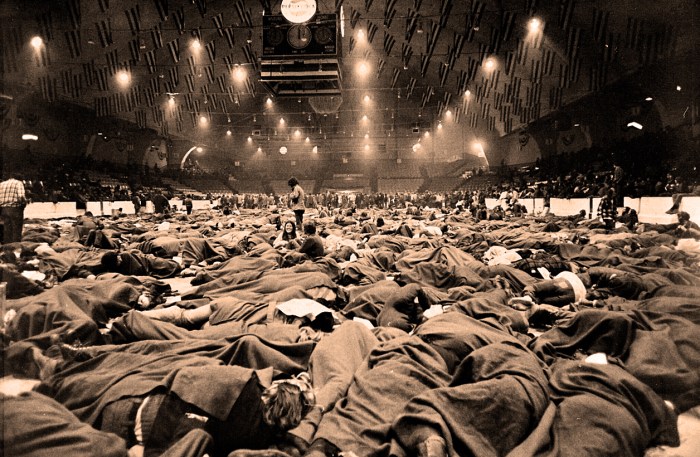
On Tuesday we marched to the Justice Department, where John Froines spoke and was arrested and charged with conspiracy. The rest of us, about 3500, were arrested too. I had connected with Philadelphia people again and was arrested with them. Upon discovering that we were from Philadelphia, the police handled us with added roughness, saying that we were used to it. The police under Rizzo had become nationally notorious in their unsympathetic treatment of protestors. The jails were grossly overcrowded. Many were rounded up in the car park of a stadium with no food or sanitary facilities. I was in a cell meant for two with twenty or more crowded into it. We kept our spirits up, singing Power to the People and such songs all night. On Wednesday we were arraigned and released and attended further meetings and protests.  We had a big demonstration at the Capitol, where over 1200 were arrested. There were 13,500 or so arrests in those three days, setting the record for mass arrests.

On Thursday I returned to Philadelphia with my regional group, but on Friday I returned to DC again. There was a meeting in the office to make last minute preparations for a weekend retreat (with a lot of emphasis on security arrangements). We set out to a big house in the country where we were to evaluate May Day and make plans for further actions. It was one of the weirdest weekends of my life. There was a punch served, which was laced with acid or mescaline or both, and this was the occasion of my bad trip. I was overcome by paranoia. The whole atmosphere of arrests, conspiracy charges, infiltration of the movement made for an atmosphere of paranoia already, but the drugs intensified it to a terrible degree. I cried for much of the night. There were also separate women’s and men’s meetings and heavy criticism-self-criticism about sexism in the movement, particularly in and around May Day. There was a lashing out against the male movement heavies, who were in the limelight, especially Rennie and John, who were there, out on bail. I had my doubts about this grouping conceiving of themselves as the leadership of a national movement. John and Rennie might have had their blind spots, but some of these people represented nobody, did not really think politically, were too self-indulgent in too many ways. Some were undoubtedly informers and provocateurs. A big conspiracy trial could be looming and a number of us, as well as Rennie and John, could be indicted as co-conspirators.

On Monday 10 May I went back to Philadelphia for a meeting of the Philadelphia coalition as well as meetings of smaller groups to evaluate the spring offensive. I spoke at all of these meetings at national and regional levels. I thought that we had succeeded in disrupting the government, set records for mass non-violent civil disobedience and dramatised the high degree of disaffection with the war, both at the mass demonstration organised by NPAC-PCPJ as well as the VVAW and Mayday actions. It had rattled the government and shown them that they could only carry on the war at the price of civil unrest involving high numbers as well as militant actions. The militant actions even got support from some federal workers and national guard as well as many in the local black community. Evidence would later emerge that the government was shaken by having to show such massive force to keep public order in the nation’s capital and that these demonstrations had played a  role in pressurising for an end to the war.

However, some had taken too literally our threat to stop the government and were too in thrall to a romanticised military model and with physical confrontation. I argued for a way going forward that would involve more than physically coming together either in one big demonstration or in disruptive tactics, such as blocking traffic. I thought that we should move forward by finding ways to mobilise scientists as scientists, teachers as teachers, factory workers as factory workers to oppose the war and even to link with their counterparts in Vietnam. The whole thrust of the people’s peace treaty was to make peace with Vietnamese rather than just petitioning the government to do it for us. It was effectively entering into foreign relations on our own, which was considered treasonous, as those who had travelled to North Vietnam had been told by the US government. It was the same with the Veneremos brigades going to Cuba. Projects such as Science for Vietnam and Medical Aid to Indochina carried the movement on in this direction.

On Thursday of that week I returned to DC again, where we had a demonstration where we read the names of those who had signed the people’s peace treaty on the steps of the Capitol. I went to more meetings and more long talks in DC and then at home. On Monday 17 May I headed for New York and then New Haven. There was a high profile BPP trial in which Bobby Seale and Erika Huggins were accused of conspiracy to murder fellow black panther, Alex Rackley, who had been suspected of being an informer. There had been big demonstrations when the trial had begun a year ago. Many Yale students had joined the protests and the president of Yale, Kingman Brewster, stated that he had doubts about whether black panthers could get a fair trial. We kept vigil on New Haven Green, while the jury was charged and deliberated. A week later the jury was deadlocked, a mistrial was declared and the defendants were set free. During the week all through the day we took turns going into the courtroom, but otherwise we were outside having intense discussions on the movement and where it was going.

Webinar on "Sir, No Sir"


"Sir, No Sir"
 
Program postponed until around Veterans Day


5:30 p.m.  Free viewing of new release

7:00 p.m.  Webinar with film maker  and invited guests

Register here


The film about resistance to the Vietnam war within the US military

Sir No Sir | Displaced Films   https://www.displacedfilms.com/films/sir-no-sir/

see the trailer


David Zeiger
Director/Writer/Producer

David Zeiger received a 2010 Guggenheim Fellowship for his debut narrative feature, Sweet Old World, which premiered in 2012 at the Atlanta Film Festival and is distributed by Passion River Films.

With a development grant from the National Endowment for the Humanities, he is currently in production on a feature documentary, May 1970, telling the story of the nineteen sixties student movement and the government’s attempts to suppress it.

His 2005 film, Sir! No Sir!, premiered at the Los Angeles Film Festival where it won the Audience Award for Best Documentary. It went on to win Best Documentary at the Hamptons International Film Festival, the Seeds of War Award at the Full Frame Documentary Film Festival, and Best Film on War and Peace at the Vermont International Film Festival. It was nominated for Independent Spirit, International Documentary, and Gotham Awards. The film garnered rave reviews during its 80-city theatrical run, including “Two Thumbs Up” from Ebert and Roeper. Manohla Dargis called it “Smart and timely” in the New York Times, and the New York Daily News wrote “This is powerful stuff, offering us not only a new look at the past, but unavoidably relevant insights into the present.” It has been broadcast on television worldwide, including the BBC, CBC/Canada, ARTE/France, and ABC/Australia, and the Sundance Channel in the U.S.

He followed that up in 2008-09 with the web series This is Where We Take Our Stand, that tells the story of “Winter Soldier/Iraq and Afghanistan,” an event in which 250 veterans of those wars gave testimony condemning them. In December 2009, he was awarded full funding from PBS’s Independent Television Service to turn the series into a film for a 2011 broadcast.

Zeiger created, produced and directed the landmark 13-part documentary series, Senior Year, for broadcast on PBS in January 2002. The series follows a group of 15 students at Fairfax High, the most diverse school in Los Angeles, through their last year in high school. About the series, Entertainment Weekly wrote, “Others have tried to document high school life, but this series succeeds where those drier efforts failed…High school is a time for experimentation, and finally, a truly experimental filmmaker is there.” Funded by CPB, NAATA, LPB, and the MacArthur and Kellogg Foundations, Senior Year was broadcast in Europe on Planete Cable, and was a premiere series on the new U.S. English/Spanish cable network SíTV in 2004.

His short film Funny Old Guys premiered August, 2002, at the Museum of Television and Radio in Los Angeles. Its television premiere was August 19, 2003, on the HBO Documentary series “Still Kicking, Still Laughing.” Funny Old Guys captures the final months of the life of Frank Tarloff, formerly blacklisted Academy Award winning writer, as he and a group of friends, all former TV and film writers, confront his imminent death.  The Band, Mr. Zeiger’s tribute to his son, aired to critical acclaim on the PBS series P.O.V. in 1998. It has screened at the International Documentary Filmfestival Amsterdam and AFI Film Festival in Los Angeles, and was awarded “Best Documentary” and “Best of Show” at the Central Florida Film Festival. The Band was broadcast in 2000 on the French/German network ARTE.
displaced@mindspring.com


Keith Mather
Presidio “mutineer” in 2018, escaped to Canada before his trial came up and lived there for 11 years, only to be arrested upon his return to the United States. Mather is currently a member of the San Francisco Bay Area Chapter of Veterans for Peace.


Jerry Lembcke grew up in Northwest Iowa. He was drafted in 1968 and served as a Chaplain's Assistant in Vietnam. He is the author of eight books including The Spitting Image, CNN's Tailwind Tail, and Hanoi Jane. His newest book co-authored with Tom Wilber and published by Monthly Review Press is Dissenting POWs: From Vietnam's Hoa Lo Prison to America Today. Jerry's opinion pieces have appeared in The New York Times, Boston Globe, and The Chronicle of Higher Education. He is presently Associate Professor of Sociology, Emeritus, at Holy Cross College and Distinguished Lecturer for the Organization of American Historians.


Webinar on May Day 1971 Mass Arrests for Civil Disobedience


Mayday 1971: What it Meant Then and Now


April 29, 2021, 7 p.m.  ET


View the webinar on youtube here     https://youtu.be/ESlJhDS2UxI


Participants in the Mayday protests shared experiences in a zoom discussion on May 26, 2021 that can be viewed here    https://youtu.be/MetZN1n477I

The chat is here.


Mayday was the largest civil disobedience protest of the American war in Indochina and in US history.  More than 12,000 people were detained or arrested in Washington.  This webinar features an account of how it was organized and what took place by participants and writers.  Panelists will discuss its effect on the war and on the antiwar movement and reflect on comparisons with the January 6 violent assault on the Capitol.


Speakers

Lawrence Roberts, author "Mayday 1971"

L.A. Kauffman, author  "Direct Action: Protest and the Reinvention of American Radicalism,"

Judy Gumbo, Mayday staff, author Yippie Girl

Jay Craven, national Mayday organizer, film maker

Phil Hirschkop, attorney

Sheila O'Donnell, private investigator

Bill Zimmerman, Illinois Mayday organizer, Medical Aid to Indochina

John McAuliff, Moderator, Indiana Mayday organizer


We depend on viewers' support to cover costs for this and future webinars.  Tax deductible contributions can be made here.


Scroll down for personal stories from Mayday.


Lawrence Roberts has been an editor of investigative journalism for most of his career. He's worked at the Washington PostProPublica, Bloomberg News, and the Hartford Courant, and was executive editor of the Huffington Post Investigative Fund. He was a leader on teams honored with three Pulitzer Prizes.

Roberts started out in the Pacific Northwest, where he helped create an alternative weekly, the Seattle Sun. He served as bureau chief for United Press International in Madrid, Spain, and taught journalism at Wesleyan University as a Koeppel Fellow. He lives in the Washington, D.C. area. Mayday 1971 is his first book. His website: www.lawrenceproberts.com


L.A. Kaufman is the author of acclaimed movement history, Direct Action: Protest and the Reinvention of American Radicalism, which opens with a penetrating essay about May Day 1971 and was reviewed by Rebecca Solnit for the New York Times as “the best overview of how protest works – when it does – and what it’s achieved over the past 50 years.” 


Kaufman has spent more than 35 years immersed in grass roots movements, as historian, journalist, organizer and strategist.  Her writings on organizing and social movement history have been published in The Guardian, The Nation, The Progressive, Mother Jones, The Village Voice, The Baffler and others.  She was a central organizer of the two-year direct action campaign that saved more than 100 New York City community gardens from bulldozing in 1999 - and was the mobilizing coordinator of the massive anti-war protests of 2003-2004. More recently, she was a key organizer of successful campaigns to save two iconic New York Public Libraries from being demolished and replaced by luxury towers.  


Phil Hirschkop is the lawyer who managed overall legal actions and strategies for May Day 1971.  Hirschkop "started his career at the top" by taking on Mildred and Richard Loving as clients in a landmark case (Loving v. Virginia) that ended the enforcement of state bans on interracial marriage – and was made into the Academy Award nominated film, Loving.  The ACLU assigned the case to him and fellow volunteer cooperating attorney Bernard Cohen who shared the oral argument for the petitioners before the United States Supreme Court.


Hirschkop went on to argue two additional cases before the Supreme Court in the 1970s. His other clients have included Martin Luther King, Jr. H. Rap Brown, Norman Mailer and "numerous anti-war protesters during the 1960s and 1970s." Hirschkop has served on the ACLU's national Board of Directors and as Chair of the ACLU of Virginia, which he helped found in 1969. He also served as executive director of the Penal Reform Institute.  In the 1960s, after the McCarthy era, he served as the vice chair of the National Committee to Abolish the House Un-American Activities Committee, which now is the Defending Dissent Foundation.


Sheila O’Donnell is a long-term peace and justice advocate who is a licensed CA Private Investigator; her career was informed by her anti-war activism.  She was a partner in ACE INVESTIGATIONS and was involved in major cases throughout her forty-five year career both nationally and internationally with trial preparation her specialty.  She taught workshops for many years on Common Sense Security to teach activists how to keep themselves and their projects safe from those who would stop their resistance.  


She has been on many Death Penalty teams as an Investigator and Mitigation expert; her first [1978] ended with the release of Johnny Harris who was imprisoned on trumped up charges in Mississippi. She co-founded PUBLIC EYE magazine to expose government misconduct and the rise of the right in the mid-seventies; the magazine is currently published by POLITICAL RESEARCH ASSOCIATES and can be found on their webpage.    She co-founded another magazine, PROPAGANDA REVIEW, that ceased publication after several successful years. 


In 1990 she became a facilitator at the Center for Attitudinal Healing with her first bout of cancer 

and in 2000 co-founded an ongoing group, Women Living Well with Metastases and is thriving with no evidence of disease after three recurrences.  She elected for amputation of her left arm in 2019 and is now a Certified Peer Counselor with the AMPUTEE COALITION.  


She co-founded community radio station, KWMR-FM in West Marin, CA that is in year twenty-one with all volunteer programmers; this started in response to a wild land fire leaving residents of the 

rural area with no information as the fire raged taking homes and forest lands.  She is happily retired living the good life in northern California.


Award-winning filmmaker, teacher and impresario Jay Craven participated in the December 1970 Peoples Peace treaty delegation to Vietnam – and subsequently helped organize the May Day 1971 antiwar civil disobedience demonstrations in Washington, D.C. where nearly 13,000 people were arrested.  He has also been active on issues of civil rights, nuclear power and U.S. interventions in Central America.  His 1980 documentary film, “Dawn of the People,” chronicles Nicaragua’s National Literacy Campaign and his most recent narrative picture, “Martin Eden” (2021) is based on Jack London’s autobiographical novel of the same name. 


Judy Gumbo is an original member of two late 1960s satirical protest groups - the Yippies and W.I.T.C.H. Judy attended and worked at the Chicago Conspiracy Trial where Yippie founder and Chicago defendant Abbie Hoffman told her she “should have been indicted.” No women were. She briefly managed the defendants Trial office, then became responsible for distributing Trial transcripts to national and international media. Judy is one of a very few North Americans to visit the former North Vietnam while the war still raged. She returned to travel around the United States organizing against the war and for the liberation of women.

In 1972, FBI Director J. Edgar Hoover named Judy “the most vicious, the most anti-American and the most dangerous to the internal security of the United States.” Judy’s home was illegally burglarized seven times in one year by FBI agents who also installed two tracking devices on her car, one of which she found. With that, surveillance ceased.

Judy visited Vietnam in 1971, 2017 and in 2019, when she was awarded a medal by the Vietnamese government for her anti-war activities.

Judy spent the majority of her professional career as an award-winning fundraiser for Planned Parenthood. She is the widow of Yippie founder Stew Albert with whom she has a daughter, and of David Dobkin, founder of Berkeley Cohousing. Judy is now married to Art Eckstein, distinguished professor and author, among others, of “Bad Moon Rising: How the Weather Underground Beat the FBI and Lost the Revolution.” Judy likes to say the FBI brought them together.

Find Judy Gumbo on her website www.yippiegirl.com or on Facebook.


Bill Zimmerman organized for, participated in, and was arrested at Mayday ’71. In 1972-73, he built and led Medical Aid for Indochina. In North Viet Nam in May 1972, he filmed civilian bomb damage and made the documentary, Village By Village. In 1974-75, he helped lead the Indochina Peace Campaign. After the war, he managed Tom Hayden’s 1976 campaign for the US Senate, then began a long career as a political campaign manager and media consultant serving progressive candidates and nonprofits nationwide. He is the author of Troublemaker: A Memoir from the Frontlines of the Sixties.


John McAuliff is the executive director of the Fund for Reconciliation and Development and coordinator of the Vietnam Peace Commemoration Committee.  As a student at Carleton College, he organized support for the Student Nonviolent Coordinating Committee and participation in the Mississippi Summer Project of 1964.  After serving in the Peace Corps in Peru, he became the first President of the Committee of Returned Volunteers, leading its participation in the Vietnam anti-war movement, including the demonstration at the Chicago Democratic Convention.  He represented CRV in national anti-war coalitions and the U.S coalition at international conferences in Sweden.  For ten years he directed the Indochina Program in the Peace Education Division of the American Friends Service Committee, traveling on its behalf to Hanoi with a delegation that arrived on April 30, 1975, the last day of the war.  In 1985 he founded the Fund for Reconciliation and Development to continue his AFSC work for normalization of relations with Vietnam, Laos and Cambodia.  After that was accomplished in 2005, he refocused most of his work on a similar goal with Cuba.  He was "detained" at the March on the Pentagon and the Mayday civil disobedience action and while demonstrating against George Wallace during his Presidential campaign in New York. 


Resources


Mayday 1971 

by Lawrence Roberts


Direct Action

Protest and the Reinvention of American Radicalism

by L.A. Kauffman, Verso Books

excerpt on Mayday here 

https://longreads.com/2017/01/20/in-1971-the-people-didnt-just-march-on-washington-they-shut-it-down/


Troublemaker

A Memoir for the Front Lines of the Sixties

by Bill Zimmerman

with a chapter on Mayday

"A riveting book."  -- Dan Ellsberg


"How 1971’s Mayday actions rattled Nixon and helped keep Vietnam from becoming a forever war"  Unparalleled in its size and variety of actions, the last and largest national anti-Vietnam War demonstration offers lessons for challenging U.S. militarism today.  

by Robert Levering  in Waging Nonviolence


"May Day 1971 Was a Day Against War"

by Steve Early in Jacobin


The First On-Air Original Broadcast by NPR was about Mayday, listen here


"Protesters shut down D.C. traffic before. It helped end the Vietnam War — and reshaped American activism" by Hannah Natanson,  The Washington Post

https://www.washingtonpost.com/history/2019/09/23/protesters-shut-down-dc-traffic-before-it-helped-end-vietnam-war-and-reshaped-american-activism/


Mayday Excerpt from Navigating the Zeitgeist by Irish writer Helena Sheehan, click here

https://vnpeacecomm.blogspot.com/2021/04/helena-sheehan-writes-about-mayday.html


May Day organizing film used for promoting participation in the event, click here

https://vimeo.com/user13347089/review/455214871/ab24692c94


"May 3, 1971 – The Day They Arrested 7,000 Demonstrators In Washington D.C."

NBC Nightly News (audio only)  Gordon Skene Sound Collection

https://pastdaily.com/2019/05/03/may-3-1971-the-day-they-arrested-7000-demonstrators-in-washington-d-c/


May Day Raw

Compilation on vimeo of contemporaneous news accounts and later interviews, John Kerry's testimony at the Senate Foreign Relations Committee, click here

https://vimeo.com/ondemand/mayday1971raw/243783364


Personal Stories


Peter Weyland
Mason Neck VA
Drove up from Hampden-Sydney College. My Mom was CIA and personnel supervisor in charge of SE Asia dropping operatives behind the lines. I didn't realize until years later. Both my parents were unfavorable towards the war. My Mom lost a # of people.


Rick Halperin

Dallas  TX 

I was an undergrad at George Washington Univ. during the tumultuous years 1967-1968, 1969-1971 (I studied in Paris 1968-69)...From the march on the Pentagon in Oct. '67, through the Nov. '69 Moratorium, the May riots of 1970 following the Kent State killings to the May Day riots and arrests...I would not trade my experience in and out of the classroom for anything in the world.

I bring those days and my own experiences into my own classroom teaching today, and am saddened, but not surprised, that the overwhelming majority of my students have had no knowledge of those years, and have never even heard of such defining events at the 1968 Orangeburg Massacre in S.C., the My Lai Massacre, or the killings at both Kent State and Jackson State.

It is a constant reminder of how each successive generation of young people has been, and is being, academically failed by having no (mandatory) exposure to the pedagogy of Human Rights education in this country.

I am blessed to be the Director of our university's undergraduate Human Rights program, one of only 7 (!!) such programs in the USA.  There are zero (!!) Ph.D. programs in Human Rights in the US today.

Dr. Rick Halperin, Director, Southern Methodist University (SMU) Human Rights Program  


Charles/Pauline Sullivan 

Washington DC

I think there were three movements that resulted in our arrests in May Day. They were the Vatican Council in the early sixties, the civil rights movement and, of course, the anti-war movement. Charlie was first stationed as a priest in Demopolis, Alabama, which is very near Selma and it was in 1966 right after the March. Pauline was a stationed as a nun at St. Stephen's school which was In "the Reservation" in Minneapolis.  Pauline played a role in the start-up of the American Indian Movement.

When they met in 1969, Charlie was working on a revolution in the Catholic Church. Pauline replied that she was interested in the "other" revolution---the revolution in the world! 

In 1970, they left Minnesota in a $400 VW van (that broke down a lot) to seek their place in the revolution.  They lived in the van for over a year, travelling to Mexico and Canada as well as involved in demonstrations throughout the United State.  

They also visited people like Dorothy Day. This visit in New York City was in early September, 1971, because we had to return to DC for our May Day trials. While waiting for our trials, we lobbied against the military draft and at night in our van parked on Capitol Hill, we listened to the VW radio report on the uprising at Attica.

We had briefly been involved in Texas in our travels, but decided then to return to San Antonio and get totally immersed in prison reform. We started in 1972 with a bus service for families to visit their loved ones in the prison system and started organizing these families on the buses into an organization we called CURE.

In 1974, we moved to Austin and CURE became a statewide organization. In 1985, we moved to Washington  and expanded CURE nationally. In 2001, we had our first international conference and now have a strong presence in Africa and Asia.

Pauline was right in that our commitment to revolution in the world and, as you can see, started in a way with May Day and still continues even though we are in our eighties. Charlie 

PS. We are still very Catholic, but not revolutionary Catholics. We have enough to keep us busy with prison reforms!

 We are ever reminded about the quote from George Bernard Shaw " When I die, I want to be all used up!"  cure@curenational.org


Nina Lazar 
Cedar Grove, NJ 
I was active during Civil Rights Movement and during the Vietnam War years.  I was at the '63 March on Washington and had been to almost all the anti-war demonstrations in DC and in NYC.  However,  I had just had my first child in March, '71 (he just turned 50, of course) and I wasn't even considering going down to DC with a newborn.  And while I was always involved  - I organized on campus and then after graduation, among my teacher colleagues - I wasn't willing to be arrested.

Those who are willing to be arrested have my respect and support. My granddaughter was arrested twice in Brooklyn during the BLM demonstrations last year.  I was very proud of her participation and dedication to the struggle for equal justice.  BTW, Kenna, said granddaughter, is 1/2 Vietnamese, and she is presently working outside of Ho Chi Minh City, teaching English.   

We can never forget the war, the painful losses and the movement, which had incredible influence.  I certainly believe in the power of protest!  


Lawrence Dworkin
Media PA
Went to 14th St. Bridge.  As a result of tear-gas most demonstrators fled.  My friends and I (7) walked around looking for intersection to sit in.. Walking towards one we saw the look on police officer's face as in "please find another spot to come to, I'm having a rough day.  We moved on.  Later arrested (because the sergeant told the cops to) and spent night in DC prison yard which was better than the cell.


Wendy Brawer 
New York, NY 
Green Map System  As a high schooler from Detroit, I had a life-changing experience those days in DC - all positive. 


Zelda Gamson
Brookline,MA
Retired,  University of Massachusetts Boston
I was in an affinity group with Howard Zinn,  Noam Chomsky,  Marilyn Young,  Daniel Ellsberg,  and 2 or 3 others. Got maced with Dan did not know at the time,  nor did I know afterwards that this was such an important protest. Why would this have been so? I was not arrested,  as Zinn was. Marilyn and I had small kids at home and courses to teach so decided not to get arrested. Glad that didn't make a big difference.


Kurt Jacobsen
Chicago IL
Swept out of Potomac Park. Blocked traffic with mixed success next morning. Tear gassed,  knock down by a motorcycle cop.


Ken Brociner
Somerville MA
One of the strangest memories of my time in the anti-war mvt was being fast asleep in  a sleeping bag on the ground in Potomac Park and being woken up by a helicopter flying  overhead telling us to leave the park within (20?) minutes or face arrest.  Blocked a street leading to Key Bridge - chased into a backyard by a cop who then threatened to send me to a hospital while he a


Helena Sheehan
Dublin, Ireland  
I have written about my experience of Mayday in my book Navigating the Zeitgeist (NY: Monthly Review Press,  2019)  I was a Mayday organizer,  first from Philadelphia and then based in DC as part of the Mayday collective. 


Bob Young
Merrick NY
Arrested at Dupont Circle early AM on May 3rd. 


Woody Widrow
Austin US
I was arrested and taken to the DC jail and eventually the charges were dropped.


Brian Spears
Atlanta GA
Arrested outside of Department of Justice


Wayne Smith
RI   
I was serving in Vietnam as a combat medic.  When gathered with some like minded friends,  we avoided all combat!


John Greg Miller
San Jose CA
May 5, 1971 was a transformative experience for me, as I was attacked and beaten by the SFPD Tac Squad for participating in non-violent actions against the Viet Nam War.  I learned how police lie to cover up their violent actions.


Michael Organek
Springfield VA
Retired U.S. Civil Service Whore "I was arrested on May 3,  on Constitution Ave,  and initially put in an outdoor double fenced field.  At night fall,  we were transferred to the old D.C. Convention Center.  I was released late in the afternoon on May 4th.   May 5th,  arrested again,  on the steps of the U.S. Capitol building,  and was put back in the old D.C Convention center,  for about 36 hours.  I was part of the Class Action Lawsuit,  ""Dellums et al vs. the Washington,  D.C. Metropolitan Police Dept.""  In 1981,  as a result of the class action lawsuit,  I received $2, 179.49.  I have had Cerebral Palsy since birth. "


Dave Logsdon
Minneapolis MN
Veterans For Peace "I dissented while in the military and was sympathetic and appreciative of anti-war activists. The vast majority of Veterans For Peace continue to organize in opposition to all past and present wars."


Mark Looney
Averill Park NY
How was nonviolent training for civil disobedience utilized and implemented for the May Day protests? What was the People’s Lobby that occurred in DC then and how did it differ from the May Day protest?


Stephen Lorenz
Silver Spring MD
Vernacular Music Association  I have delivered papers on Mayday to the DC Historical Society,  looking forward to the talk.  


Ken Mayers
Brooklyn NY
St Francis College,  Amnesty International USA "I was pretty young and had just moved to State College,  PA (Penn State University) from Washington,  DC.  What are lessons learned that we can share with protesters in 2021?"


Detentions and arrests at the Washington Coliseum 


Representative Bella Abzug addresses May Day Supporters on the Capitol Steps