Webinar The Women: Our Impact on the Vietnam Antiwar Movement

September 19, 2024, 4-5:30 PM ET


View the webinar on youtube by clicking here

and share this link   https://youtu.be/dvOFA4VQUaA


Please also share the link for this page with friends, colleagues and on social media  

https://vnpeacecomm.blogspot.com/2024/09/women-and-antiwar-movement.html


The ultimate success of the movement to stop the war in Vietnam was due to the mobilization of multiple segments of society, such as students, academics,businesspeople, lawyers, religious activists, unions, veterans, and humanitarians.  Not least of these were traditional women's peace organizations such as the Womens International League for Peace and Freedom and Women Strike for Peace that redirected their efforts toward stopping the war, and newer Vietnam War specific groups such as Another Mother for Peace and Gold Star Mothers for Peace.  This webinar features the experiences of women peace activists who helped to transform the movement into a broad coalition that reached into a majority of American households and influenced the movement for women's liberation. 


Moderator:

Linda J. Yarr is a Research Affiliate of the Center for Asian Studies at the University of Colorado, Boulder. She also serves as a member of the Board of Directors of the journal Critical Asian Studies, successor to the Bulletin of Concerned Asian Scholars published by The Committee of Concerned Asian Scholars. Previously she was a research professor of international affairs at George Washington University and served as director of Partnerships for International Strategies in Asia. She has authored articles, book chapters and reviews on Vietnam and Southeast Asia. As a student in France during the war in Vietnam, she was a member of the Paris American Committee to Stop the War. She holds a master’s degree from Cornell University, an advanced degree in international relations from Sciences Po in Paris, and a B.A. from D’Youville College (now University).


Speakers:


Leslie Cagan has organized peace and justice movements for more than 60 years. From nuclear disarmament to lesbian/gay liberation, from the Rainbow Coalition to Queers Against Israeli Apartheid, support of Palestinian rights to normalizing relations with Cuba, fighting sexism to confronting police brutality to climate justice, she’s been a central organizer in many struggles.

Her organizing began in the early-1960’s at NYU in the student wing of the movement against the US war in Vietnam. She served on the Coordinating Committee of the National Student Mobilization Committee Against the War in Vietnam and was part of the NYC Fifth Ave. Peace Parade Committee. Her antiwar work continued in St. Louis and Cambridge.

Leslie was the National Coordinator of United for Peace and Justice, a coalition of 1,400 groups central to the movement against the war in Iraq. Her coalition-building and organizing skills have mobilized millions of people in many of the nation’s largest demonstrations, including the 1982-million-person Nuclear Disarmament demonstration in NYC; the1987 lesbian/gay rights march on Washington; massive mobilizations against the Iraq War from 2003 to 2007; the 2014 People’s Climate March in NYC; and the 2019 Queer Liberation March in NYC on the 50th anniversary of Stonewall.

Her writings appear in ten anthologies and in scores of print and online outlets; she has done more workshops, conference presentations, and speeches at rallies than she can count. 


Le Anh Tu Packard's first significant antiwar talk was to a group of skeptical U.S. naval officers in 1969 at an Episcopal church in Wickford, Rhode Island. They were surprised to learn that their “enemy” Ho Chi Minh was allied with the U.S. Office of Strategic Services (the precursor to the CIA) toward the end of World War II. While a student, Tu participated in demonstrations organized by Asians Against the Vietnam War and encouraged the student body at her college to support the People’s Peace Treaty. In 1971 she joined the National Action/Research on the Military Industrial Complex (NARMIC), a project of the American Friends Service Committee. She spoke at peace actions that included the Womens March Against the Presidio and the Winter Solder Investigation at Faneuil Hall. In 1972 Tu and Marilyn McNabb co-authored “Aid to Thieu”, a NARMIC report on the use of U.S. military and economic aid to prop up the Thieu government. Tu also worked closely with Peggy Duff, Gabriel Kolko and Richard Falk in a successful campaign to oppose secretive efforts by the U.S. government to use World Bank funds to aid the Thieu administration.


Vivian Rothstein was introduced to activism through the civil rights movement of the 1960s. She was a Mississippi Freedom Summer volunteer in 1965 and later a community organizer in Chicago working to build “an interracial movement of the poor”.

In 1967 Vivian participated in a conference in Bratislava, Czechoslovakia co-sponsored by Liberation Magazine which brought 45 diverse American peace activists together with representatives of North Vietnam and the insurgents in South Vietnam, represented by the Provisional Revolutionary Government (PRG), to build understanding of the American war in Vietnam.  Following the conference, she and 6 other participants travelled to North Vietnam to witness the impact of U.S. bombing on the country and people of North Vietnam. The delegation, headed by Tom Hayden, spent 17 days visiting bombed sites including schools, villages and hospitals, reviewing the American weaponry used against the Vietnamese people, and learning how the North Vietnamese mobilized to survive the onslaught.  They also met with American POWs being held in Hanoi and brought back letters from them for their families.

Upon returning to the U.S. Vivian spoke widely to audiences in the Midwest to share what she had learned in North Vietnam about our country's intentions.  She helped organize the Jeannette Rankin Brigade in January 1968, the first national women's march in Washington D.C. against the Vietnam War, as well as subsequent meetings between American and Vietnamese women in Toronto, Canada.

In 1994 Vivian returned to Vietnam on a women’s delegation, coordinated with the Vietnamese Women’s Union, to highlight the need for normalized relations between the U.S. and Vietnam.  Vivian donated her anti-Vietnam War posters to the Women’s Museum in Hanoi. 


Cora Weiss has spent her life in the movements for human rights, civil rights, women’s equality and peace. She was the UN Representative of the International Peace Bureau (Nobel Peace laureate 1910), which she led as President, 2000-2006; is among the founders of the Global Campaign for Peace Education and was a civil society drafter of what became UN Security Council Resolution 1325 on Women Peace and Security unanimously adopted in 2000. Her dedication to peace and peace education has garnered several nominations for the Nobel Peace Prize. Adelphi University awarded her the Honorary Doctor of Laws degree.

During the war in Vietnam, she represented Women Strike for Peace (WSP) as the only woman of 4 co-chairs of the National Mobilization which organized the Nov. 15, 1969 demonstration in DC against the war in Vietnam. With Rev. Richard Fernandez she tried to bridge  the Mobilization with the Moratorium. She was co-Director with David Dellinger of the Committee of Liaison which arranged for the monthly exchange of mail with prisoners of war and their families, increased the number of packages POWs could receive, returned with the first list in Dec. 69 of those alive, and brought home 3 pilots in 1972. The Committee arranged for 3 Americans to travel to NVN every month carrying mail and who returned with eyewitness accounts of the war. She was a leader of the Jeannette Rankin Brigade, linking WSP with the religious and African American communities which called for Ending the War in Vietnam and Poverty and Racism at Home.  She was a director of Friendshipment, which helped to rebuild Bach Mai Hospital; served as Consultant to Church World Service organizing a shipment of 10,000 tons of wheat and was a member of the delegation which delivered it to reunified VN (1978).


Resources


The Movement: How Women's Liberation Transformed America, 1963-1973, Clara Bingham, One Signal Publishers/Atria, 2024  includes interview with Marilyn Webb


Revolutionary Feminism: The Women's Liberation Movement in Seattle (Duke U Press, 2023) by Barbara Winslow

 I have an entire chapter about feminist anti Vietnam and anti imperialist organizing. I think it is one of the only academic/popular discussion of this topic. Using mainly primary sources, I write about the involvement of women in the anti-draft and anti-war movement; how we brought a gendered analysis of war and imperialism into the anti war movement, how we fought and won to get more women's speakers at anti-war rallies. We brought a gendered analysis into the anti‚ draft movement; we worked in the GI coffee The Shelter Half in Tacoma and worked with Jane Fonda when she brought her FTA show to Tacoma, close to an airforce and army base.  - Sea Tac airport was then the second largest disembarkation‚ point to Vietnam; women regularly leafleted at the airport.We were involved in meetings with Vietnamese, Laotian and Cambodian women in Canada many times. 


Women's Anti War Diplomacy During the Vietnam War by Jessica M. Frazier, University of North Carolina Press, 2017


Hanoi Journal 1967, Carol Cohen McEldowney, edited by Suzanne McCormack and Elizabeth Mock University of Massachusetts Press 2007


Women Strike for Peace by Amy Swerdlow, University of Chicago Press, 1993


Radicals on the Road -- Internationalism, Orientalism, and Feminism during the Vietnam Era by Judy Tzu-Chun Wu, Cornell Press 2013


Mrs. Van's Video Message to American Women Patriots -- The Vietnam War Remembered from All Sides by Christian G Appy, Viking Penguin 2003 ( in Antiwar Escalations page 274 "What? Meet separately with women?" Vivian Rothstein)


Speech by Vietnam Women's Union Representative:


Draft itinerary and costs for 50th anniversary program in Indochina


(revised 2/12/25)     

A Unique Opportunity to Personally Witness Consequences of Conflict, Achievements of Peace and Regional Challenges.


April 30, 2025 is the 50th anniversary of the end of the US war with Vietnam, an historic event for a generation in both countries. The Fund for Reconciliation and Development is facilitating a two week travel program for Americans that engages Vietnam's history, culture, cuisine and current challenges. It offers insights, experiences and people to people meetings unavailable on commercial tours.


We will visit the encampment in Tan Trao where personnel of the Office of Strategic Services (OSS) worked with Ho Chi Minh in 1945 and conclude with ceremonies in the city carrying his name (formerly Saigon) celebrating half a century of peace and reunification since 1975.


We will learn about ongoing efforts to heal the wounds of war from land mines, unexploded ordnance and Agent Orange.


We will update ourselves about the strong economic, political and educational ties that constitute a comprehensive strategic partnership between the US and Viet Nam, despite (or because of) the danger of conflict with China.


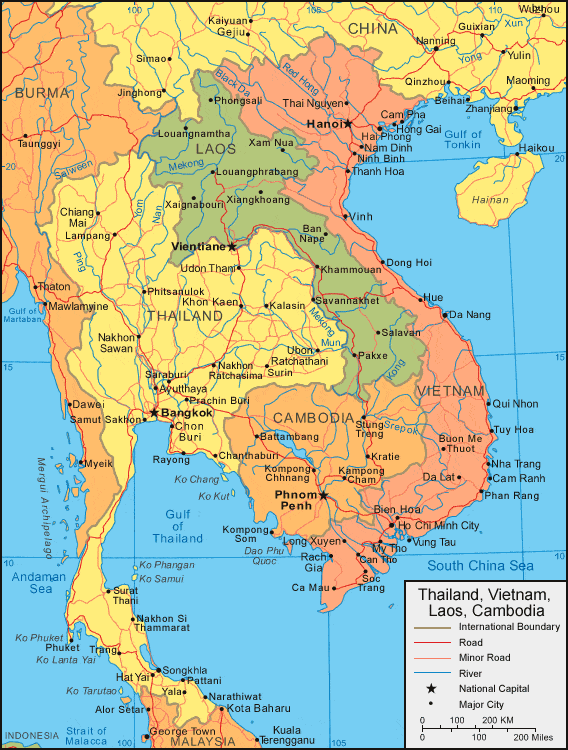
The group will travel by plane and tour bus from Ha Noi to Quang Tri, Hue, Da Nang, Hoi An, My Lai, Con Dao Island, Ho Chi Minh City and Ben Tre in the Mekong Delta hosted by the Viet Nam - USA Society, Click here for the itinerary and registration information.


The Fund for Reconciliation and Development (FFRD) has coordinated more than twenty educational tours in Indochina led by founder John McAuliff since 1985 and anticipates this is the final such program.


Below is the current version of the itinerary of the program in Viet Nam hosted by the Viet Nam - USA Society (VUS) for people who participated in the antiwar movement, worked on normalization of relations, or have addressed war legacies, plus family members and friends.  Persons with a professional or collegial interest are also welcome.  There is personal flexibility at the beginning and the end, including the option to add a visit to Cambodia and Laos.

Participants will be responsible for international travel and for domestic costs of a fifteen day guided program in Viet Nam .  The estimated domestic cost for sharing a room is $2,500 each.   A single room is $3,050.  Costs may be adjusted by number of participants.  Payment is in cash (USD or Vietnamese dong) on April 15th in Ha Noi. 

Breakfast, lunch and two dinners are included.  All other dinners are on our own.  FRD/VUS will suggest locations and we often will invite guests.  Participation in group dinners will be at an equal share cost.  Some menus will be pre-set and others a la carte.  

The maximum size group is 25.  

For planning purposes, expressions of individual, family and organizational interest are appreciated as soon as convenient.  No committment is required prior to February 28, 2025.  Write to jmcauliff@gmail.com

If you are ready to commit, please complete a registration form and donate for FRD organizing costs at least $200 per person.  We are facilitating this trip but are not a travel agent or tour operator.  FRD is not legally liable for trip cancellation, transit or in-country illness or accidents.  We strongly recommend obtaining travel insurance when you book your flight.  International flight costs are usually less expensive if booked sooner.  Transit destinations include Thailand, Hong Kong, Taiwan, Malaysia, Korea, Singapore, Kuala Lumpur and the Philippines.  You may be able to use airline milage for the transpacific flight to one of those locations in premium economy or business and then buy a ticket in economy for the shorter final leg.


Registration forms are available by clicking here  https://form.jotform.com/73274097780970  Return it with the administrative support contribution and a copy of your passport page as soon as possible.


Itinerary of FRD’s delegation to visit Viet Nam

From 15  April - 1 May, 2025


As of 4/2/25 


Sunday, April 13-15:     

Arrive in Noi Bai Airport

[option for jet lag recovery pre-program tourism April 13-14:  overnight in Ha Long Bay/ Ninh Binh/ visit to pottery village, etc. to be arranged by VUS on request]  


Tuesday April 15: HA NOI

Arrivals for program

08:00 pm   Orientation meeting at hotel.

         Check in Splendid Premium Hotel No 36 Lo Su Str., Hoan Kiem Dist.


Wednesday, April 16: HA NOI

08:00am       Visit Ho Chi Minh Mausoleum, his House and Museum, Literature Temple

02:00pm      Visit Ethnology Museum, Hoa Lo Prison

06:30pm      Water Puppet Show

07:30pm  Dinner with resident staff of US NGOs  (TBC)


Thursday, April 17: HA NOI

08:30am       Presentation “Viet Nam: 40 years of Construction and Development”

by President of the Viet Nam Union of Friendship Organizations (ok)

02:00pm     Visit Women’s Museum

03:30pm     Meet with the Viet Nam – USA Society, soldiers, high-ranking officials (ok)

06:30pm     Welcoming dinner with VUS/VUFO


Friday, April 18: HA NOI

09:00am       Visit Garco 10 equitized garment factory (ok)

11:00am       Meet with US Ambassador Marc E.Knapper (ok)

02:30pm       Visit Diplomatic Academy (ok)

05:30pm       Optional Visit home of Mark Rappoport

06:30pm       Dinner with members of US business community (TBC)


Saturday, April 19, 2025: HA NOI - TUYEN QUANG – HA NOI

08:00am       Travel by bus to Tuyen Quang

 Visit Tan Trao where OSS assisted Ho Chi Minh 

04:00pm      Travel back to Ha Noi

07:30 pm     Dinner with Vietnamese friends (TBC)


Sunday, April 20: HA NOI - HUE

Morning        Relax 

Afternoon   visit the new military museum on the way to the airport (TBC)

05:00pm      or  Leave Hotel for Noi Bai Airport

07:45pm       Flight to Hue. Flight No. VN1549 M

09:00pm       Arrive in Hue. Transfer to Hotel. Check in Hotel

                        Addr: Huong Giang Hotel, 51 Le Loi Str. Hue city


 Monday, April 21:

08:00am     Visit Thien Mu Pagoda & Hue Imperial Citadel

                        Visit Khai Dinh Tomb & Hat Village

02:00pm      Visit Hue National University (ok)

04:00 pm     Meeting with VUFO of Thua Thien Hue province (ok)


Tuesday, April 22: HUE - QUANG TRI 

08:00am      Check out of hotel

Leave Hue for Quang Tri by bus

11:00am     Visit war legacies (land mines, UXO)

02:30pm     Meet with VUFO of Quang Tri province

Check in Muong Thanh Hotel. Addr: 68 Le Duoan, Ward 2, Dong Ha.


Wednesday, April 23: QUANG TRI - DA NANG

                     Check out of hotel

08:00am       Leave Quang Tri for Da Nang by bus

02:30pm       Visit Da Nang Center Supporting for Victims of Agent Orange/Dioxin

04:00pm       Meet with Da Nang People’s Committee & VUFO of Da Nang city

                       Dinner with Da Nang People’s Committee & VUFO

                     Check in hotel in Da Nang


Thursday, April 24: DA NANG

08:00am     Visit Cham Museum

                     Lunch on own, free time at market

02:30pm     Visit East Sea Museum

04:00pm     Meeting at Dong A (private) University

07:30pm     Dinner with friends from Da Nang  (TBC)


Friday, April 25: DA NANG – QUANG NGAI (MY LAI) - HOI AN - DA NANG 

07:30am       Travel by bus to Quang Ngai (My Lai) by bus

Visit Son My Village - war legacies (mass atrocity) in Quang Ngai 

Afternoon    Leave Quang Ngai for Hoi An. Return to Da Nang.  


Saturday, April 26: DA NANG – (Transit in HOCHIMINH CITY) - CON DAO

09:00am       Check out of hotel. Travel to Da Nang Airport

11:00am       Flight to HCMC. Flight No. VN119 M DADSGN.

(Luggage checked through Con Dao)

12:30am       Arrive in Tan Son Nhat Airport 

03:10pm       Transit. Fly HCMC - Con Dao. Flight VN1885B SGNVCS

04:10pm       Arrive in Con Dao Airport   

                      Transfer to Hotel. Check in Marina Bay Con Dao Hotel

Nguyen Hue, Khu 5, Con Dao, Ba Ria – Vung Tau

Dinner guests local guide Truong Ai Van and one or two friends (TBC)


Sunday, April 27:  CON DAO 

Morning   Free time/Enjoy the beach, turtles, snorkel boat, hiking, island tour, etc.

Afternoon     Learn Con Dao history, East Sea issues / Visit Tiger Cage Museum


Monday, April 28:    CON DAO  - HO CHI MINH CITY

07:30pm       Leave Hotel for Con Dao Airport

09:30am       Fly to Ho Chi Minh city. Flight No. 8054B VCSSGN

10:45am       Arrive in Ho Chi Minh city. Transfer to Hotel

                        Check in Avanti Hotel, 186-188 Le Thanh Ton, Ben Thanh Ward, Dis1

02:30pm     Meet with Ambassador Ton Nu Thi Ninh, President of Peace and

development Foundation & officials of Ho Chi Minh city (ok)


Tuesday, April 29: HO CHI MINH CITY

09:00am      Meet with US Consulate 

                        Drive through of export processing zone, container port

02:30pm      Reunification Conference Hall, War Remnants Museum

06:30pm       dinner with officials


Wednesday, April 30: HO CHI MINH CITY

07:00am       - Participate State/official events (parade and celebration)

Afternoon    - Pay a courtesy meeting with High-ranking official (TBC)

.

Thursday, May 01: HO CHI MINH CITY Options

Morning        Check out of hotel. Departure.


Options:


Thursday, May 01, 2025: HO CHI MINH CITY Options

                     1)  Depart Viet Nam, or

                     2)  Shopping/personal activities, or

                     3)  Cu Chi tunnels,   or

                     4)  Cu Chi tunnels and Mekong Delta tour


Friday, May 02, 2025:  

.         Depart for home, Cambodia or Thailand


 TBC = to be confirmed


Optional additions

Friday, May 2, 2025:  HCMC- Phnom Penh  Limo Minivan $35

Saturday, May 3, 2025 - fly to Siem Reap / Angkor Wat  10 a.m.

Sunday, May 4, 2025 -  fly to Phnom Penh  7:30 p.m.  

Monday, May 5, 2025 -  Tuol Sleng KR prison, meetings

Tuesday, May 6 -- Choeung Ek burial ground, meetings

Wednesday, May 7, 2025 -  Museum of Culture, free time, fly home or to Vientiane, 5:45 p.m.  $208

Thursday - Friday, May 8 - 9,  2025  Vientiane  meetings, market, etc.

Saturday - May 10, 2025   Depart to Bangkok or Ha Noi for flights home or private excursion (Mekong lodge, Luang Prabang, Xien Quang Plain of Jars)


If you are potentially interested in participating, please send a note to jmcauliff@ffrd.org to receive updates.

Registration forms are available by clicking here https://form.jotform.com/73274097780970  

-----------------------------------------------------------------------------

*  https://vietnamnet.vn/en/visitors-flock-to-con-dao-to-participate-in-sea-turtle-conservation-2327259.html


The history of Con Dao is as turbulent as it is transformative. Once known for its infamous prison system during French colonial rule and later the American presence in Vietnam, Con Dao witnessed the suffering and resilience of thousands of prisoners who were confined on its shores. These prisons have now become places of pilgrimage and remembrance, a somber reminder of the past that shapes the collective memory of the nation.

In a remarkable twist of fate, the very isolation that once made Con Dao an ideal location for a penal colony has today turned it into a sanctuary for biodiversity. The islands have been reborn as a national park, with efforts to preserve their pristine nature and protect the rare species that call it home. Con Dao’s transformation from a place of confinement to a bastion of environmental conservation highlights its unique position in Vietnam’s narrative—a story of redemption and natural splendor that now defines this tranquil tourist destination.

https://asiapioneertravel.com/blog/con-dao/


"U S Navy challenges Vietnamese claims to seas around resort island in South China Sea" 

By CAITLIN DOORNBOS STARS AND STRIPES • December 28, 2020

https://www.stripes.com/theaters/asia_pacific/navy-challenges-vietnamese-claims-to-seas-around-resort-island-in-south-china-sea-1.656609


***********************************

Former Secretary of State and Vietnam Veteran activist John Kerry


"Anniversaries have a value, not in and of themselves, but what they can actually produce. Anniversaries can often be action-oriented events, forcing moments of redefining or improving or readjusting a relationship between countries,” said Secretary Kerry. “So as someone who invested many years in finally making peace, I hope you won't mind if I suggest something unconventional for next year. Next year let's mark those two anniversaries not by looking back, but by making sure that we are looking forward. Ending the war and making peace two decades later were never ends in themselves, they were hard fought openings to put the bitterness behind us and to work together as countries.”


at the Asia Society https://vnpeacecomm.blogspot.com/2024/10/asia-society-hostsviet-nams-president.html

Webinar Grass Roots Education by IMEP

The Indochina Mobile Education Project

Education and Activism at the Grass Roots


Tuesday, July 23, 2024   

Click here to view youtube recording  https://youtu.be/89rcAyJzgJw

The Indochina Mobile Education Project (IMEP) played a key role in educating people in communities throughout America about war damages and the human impacts of the U.S. military intervention in Vietnam and Laos. Its other purpose was to highlight an estimated 200,000 political prisoners held by the U.S. funded Saigon regime and to encourage letters to Congress.

From the fall of 1971 through 1976 following the end of the war, IMEP toured the country with large photo exhibits, films, slide shows and educational materials designed to help citizens understand the toll of the war.  Two people who had experienced the war as soldiers, humanitarian agency volunteers or journalists traveled with each exhibit visiting hundreds of communities in every state making thousands of presentations to churches and synagogues, civic organizations, schools and fraternal groups like Lions and Kiwanis Clubs.  At each stop, IMEP introduced audiences to Vietnamese food and music.  People were encouraged to reach out to their elected officials to call for the end of U.S. military aid and Saigon's repressive government. 

Ambassador Graham Martin reported to Congress  in 1976 that the indochina Resource Center and the Indochina Mobile Education Project had carried. on "one of the best propoganda and pressure campaigns the world has ever seen".

This webinar will feature people who traveled the country as IMEP organizers and tour speakers as well as local exhibit hosts in Colorado, Missouri and Massachusetts.

  • Brewster Rhoads, Moderator, Massachusetts host for IMEP team
  • Willi Meyers, Professor Emeritus, University of Missouri
  • Sally Benson, national staff, IMEP
  • Jacqui Chagnon, traveling speaker, IMEP
  • Bob Chenoweth, former POW; traveling speaker, IMEP
  • Judy Danielson, Colorado host for IMEP team


Sally Benson began her work with Ecumenical Voluntary Services on Ishigaki Island in the Okinawa Ryukyus in the summer 1961  She taught English in Tai Tung Middle School in Hong Kong 1963-64 and at the National Institute of Administration in Saigon with International Voluntary Services1967-1968.  She was a staff member of International Student House in Washington 1970-1973 and of the Indochina Mobile Education Project 1973-1976.

From 1975 to 1977 she was part of Mid-Atlantic Clergy and Laity Concerned's  "RRR" focus on diplomatic relations,  reconciliation, and reconstruction with Viet Nam. 

Sally worked with the  Asia Resource Center and was involved with organizing the Asia Pacific Center for Justice and Peace, and the Campaign to Oppose the Return of the Khmer Rouge.

Dick Berliner, John Schafer, Bob Minnich, Steve Nichols and Sally bought an old house in the wake of the Washington DC MLK Riots.  It became home for some IVSers returning home and for activists involved in trying to stop the American war in Southeast Asia It was a guest house for early delegations visiting from Vietnam

For over 20 years Sally and Steven Nichols with others have managed a foundation to help fund post conflict reconciliation and Agent Orange, UXO and environment related programs mostly in Asia.


Robert Chenoweth was born in Portland, Oregon and grew up both in Eugene and Portland.  He enlisted in the Army in June 1966 and was trained as a UH-1 helicopter crew chief.  He was sent to VN in January 1967 flying combat and combat support missions for the rest of the year.  His unit was based at Tan Son Nhut Army Heliport adjacent to the sprawling Air Force base.  He extended his tour for six months and after  leave came back to Viet Nam on January 22, 1968.  He was based at Qui Nhon and involved in fighting around the airfield and in the air.

Bob was shot down and captured February 8, 1968 during the Tet offensive.   He was released March 15, 1973 as part of the Paris Agreement on returning POWs and political prisoners. On return to the US, he and other POWs were charged with aiding the enemy because of statements they had made as prisoners.   Bob writes, "We raised our voices with the millions of Americans who were also protesting the war.  We just learned what was going on based on our military experiences and what we learned in captivity."

After release from the Army in July, 1973 he was contacted by the Indochina Peace Campaign and traveled with Tom Hayden, Jane Fonda, Jean Pierre Debris, Holly Near and Jeff Langley.  He also traveled for a couple weeks with Jacqui Chagnon and Roger Rumpf of the IMEP around the border area with Oregon and California.  About a year later Dave Davis asked Bob to travel with IMEP.  He was a film maker ("Year of the Tiger") who had been to Vietnam in 1973.  He did not have much experience with Vietnamese cooking, etc.  So I went with him in Pennsylvania, upstate New York, and Ohio.  I ended up meeting my wife in Cleveland.

Bob moved to Cleveland and continued with college that he had started in Berkeley.  He moved to Washington DC in 1975, worked at the Institute for Policy Studies and finished a degree in Anthropology.  He went to work at the National Air and Space Museum after school.  He'd worked part time at Natural History and developed an interest in museum work.  He went to work for the Naval History Center but was denied a clearance so worked as a civil engineering draftsman for several companies in the Northern Virginia, DC, Maryland area before moving to Hawaii in 1983.  He worked alot with the American Friends Servic Committee in Manoa, having gotten to know everyone when he came on an AFSC speaking tour  organized by Ian Lind.

Bob worked from 1984 to 1990 as museum technician at the US Army Museum of Hawaii then went to work as Curator of the USS Arizona Memorial with the National Park Service.  In 1992 he moved to Deer Lodge Montana to be curator of Grant-Kohrs Ranch National Historical Park.  In 1995 he moved down the road to Nez Perce National Historical Park, near Lewiston, Idaho, on the Nez Perce Indian Reservation.  He stayed in that position until he retired in 2017.  

Bob lives in Moscow, Idaho, has two adult sons, both married, and mostly play music, build models, read and mess with gardening.

He has been back to Viet Nam several times since 2013.  He donated all of his POW clothing and items to the Hoa Loa museum and attended events marking the end of the war as well as the American Dien Bien Phu.  He has spent wonderful time with Lady  Borton and Chi Mai whoworked with Jane Barton, at. al. in Quang Ngai. 


Judy Danielson  was a physical therapist with Vietnam Christian Service from 1968 to 1970, teaching and working in the Saigon Rehabilitation Center for injured civilians, largely amputees and children with polio. She was on Denver staff of the American Friends Service Committee (AFSC) from 1973-1980 organizing against the war and co-led a campaign to close the local nuclear weapons plant with Pam Solo, which led to the Nuclear Weapons Freeze Campaign.  Judy worked with AFSC's rehabitation project in Phnom Penh, Cambodia, 1985-86,  and continued as a physical therapist in Denver until retirement in 2016.  She is currently with a campaign for a non-profit universal health insurance plan for Colorado and with the Colorado Advocacy Team of the Friends Committee on National Legislation (FCNL), lobbying against war funding.  She and her spouse Eric Wright, who worked in Quang Ngai with AFSC 1967-70, have 2 daughters and 3 grandsons nearby.


William H. (Willi) Meyers  Mennonite Concientious Objecter and agriculture volunteer with International Voluntary Services in Vietnam 1963 - 65 and in IVS Washington 1965-66 as Recruitment Officer. He resigned in protest of US Vietnam policy in September 1967 and worked with Don Luce and Gene Stoltzfus to establish the Vietnam Education Project with the United Methodist Church and the Friends Committee on National Legislation.

Professor Emeritus of Agricultural and Applied Economics at University of Missouri and formerly Co-Director of FAPRI and Director of CAFNR International Programs. Areas of teaching and research have been trade, agricultural and rural policy, food security, transition economics, and EU policies and institutions. He is also Professor Emeritus of Economics at Iowa State University and Adjunct Professor at School of Economics, Management and Statistics, University of Bologna. Other professional positions have been at USDA, World Bank, FAO, Christian Albrechts University-Kiel, and Open University of Catalonia. He earned a BA in Mathematics at Goshen College, MS in Agricultural Economics at University of the Philippines Los Banos and PhD in Agricultural Economics at University of Minnesota. He authored numerous publications on trade, agricultural and rural policy, commodity market analysis, food security and transition economics, including agricultural and rural policy studies on Lithuania, Latvia, Estonia, Hungary and Ukraine after they regained independence. He is co-editor of the “Transition to Agricultural Market Economies: The Future of Kazakhstan, Russia and Ukraine” by CAB International (2015) and “Handbook on International Food and Agricultural Policies”, World Scientific Press (2017) which includes a Vietnam chapter, “Agricultural and Rural Policies in Vietnam” by Pham Van Hung and Pham Bao Duong, colleagues from Viet Nam. 


Brewster Rhoads, a native of Philadelphia, PA, was active in the anti-war movement as a student at Williams College and as an organizer for the Coalition to Stop Funding the War in Washington, DC.  He hosted the Indochina Mobile Education Project for a week at Williams College in 1974.

Brewster was a VISTA volunteer in Western Massachusetts, Director of the Washington-based Coalition for a New Foreign Policy, Director of the Green Umbrella environmental sustainability alliance in Cincinnati and the SW Ohio Regional Director for Ohio Governors Dick Celeste and Ted Strickland.  He managed over 150 issue and candidate campaigns in SW Ohio.

Brewster is currently the Chair of the Board of the Ohio River Way, Inc., a nonprofit working to promote outdoor recreation opportunities on and along the Ohio River from Portsmouth, OH to Louisville, KY.

He also serves on the boards of Adventure Crew, the Mill Creek Alliance, the Ohio Environmental Council Action Fund and Innovation Ohio.

An avid kayaker and cyclist, he is the founder and chair of the Ohio River Paddlefest, now the largest paddling event in the U.S.

Brewster lives in the Mt. Washington neighborhood of Cincinnati with his wife Ann Lugbill, a whistleblower attorney. His daughters Elizabeth and Caroline live and teach in Lund, Sweden and Berlin, Germany respectively.

brewohio@gmail.com


Resources

2011 Yen Hoang Vu, “An Evaluation of Technical Efficiency of Small Farm Households in Chuong My District, Ha Tay Province, Vietnam” M.S. Thesis, University of Missouri.

2014 Hoa Hoang, “Three Essays on Rice Markets and Policies in Southeast Asia with a focus on Rice Consumption Patterns in Vietnam”,  Ph.D. dissertation, University of Missouri

2015 Hoang, H. K. and Meyers. W.H.  Price Stabilization and impacts of trade liberalization in the Southeast Asian rice market. Food Policy 57:26-39.

Message from Prof. Marc Jason Gilbert

 My book on the anti-war movement is still in print, The Vietnam War on Campus: Other Voices, More Distant Drums, (2000) as is The Vietnam War: Teaching Approaches and Resources (1991), but much more recently I wrote a chapter on the slow moral turn of the Hawaii delegation in Washington from Hawk to Dove, from 1964-1973: ‘”The View from the Hill: Hawaii’s Congressional Delegation and the Struggle for Peace in Vietnam and equity at Home, 1964-1975,” in Brian Cuddy and Fredrik Logevall, The Vietnam War and the Pacific World  (University of North Carolina Press, 2022).  I attach the latter in an easily printout format if you have time or desire to read it. . You will note that it features Spark Matsunaga, who is the true founder of the United States Institute for Peace, which is doing great work in Vietnam right now, linking US and Vietnamese youth in conversation.

 One of my University’s satellite campus libraries shut down and gave away its books.  I was able to acquire not only the books on the anti-war movement I had it purchase (all the fundamentals), but many others from the early sixties, which may come in handy if I turn that chapter into a book. It is a look from within the Hawaii sovereignty movement (on arrival SDS bowed to local peace leadership, a miracle of sorts), and thus might be filed as a research piece that can suggest to others a way to use local culture as a frame to teach peace. Hawaiians were unable to achieve “Peace with Aloha” in Vietnam, but they tried.  My family has a close connection to Polynesia and to Hawaii which helped me see how successful such research can be. I use it even in the Historical Methods class where student complete a “site visit” reflective of Hawaiian values (including a copy of the “Hiroshima Bell”). I am very lucky that my retirement package included the ability to continue to teach a course or two a year and thus I have opportunities to still teach peace in the present situation.

Marc Jason Gilbert,

Professor of History and

NEH-Supported Endowed Chair in World History

(2006-2019, Emeritus, 2020)  

Editor, World History Connected (2008-)

66 Queen Street, Suite 2605

Honolulu, Hawaii 96813

Phone: 808.638.2563

Email: hallgilbert@earthlink.net / mgilbert@hpu.edu