McAuliff Paper for USIP on US-Viet Nam Reconciliation


Reconciliation Between Peace and Normalization, 1975-1995

Prepared for US Institute of Peace Dialogue on War Legacies and Peace,

October 13, 2022              (excerpted but not delivered because of length)


By John McAuliff


My concept of reconciliation is linked to my arrival in Ha Noi for the first time on April 30, 1975 as a staff member in the Peace Education division of the American Friends Service Committee, a Quaker organization.  By happenstance the arrival of a delegation of five anti-war activists coincided with the last day of the war and the departure from Saigon of US ambassador Graham Martin. 


I remained with AFSC for seven more years, addressing the tumultuous post war era of reunification, the US trade embargo, denial of diplomatic relations, refugees, reeducation camps, the Khmer Rouge Year Zero, their brutal attacks in the Mekong Delta and defeat by Vietnam’s military;  then China’s retaliatory invasion.   I made my first trip to the south in 1978, discovering a complex reality that was both liberation and occupation.


When I finished my decade of work with AFSC, I wanted to find ways to realistically reconcile the US with Vietnam, Laos and Cambodia and created the US-Indochina Reconciliation Project.  Our primary focuses were academics and non-governmental organizations that could not only provide substantial assistance through their interaction with counterparts in Indochina but would create ripples throughout US society and culture.    Undertaking these programs was closely tied to my ongoing contact with governmental and semi-governmental figures in all four countries.  My unusual experience and interaction with “other sides” gave credibility and allowed me to share insights in all directions, some useful, some overoptimistic and no doubt presumptuous.  My goal was to convey spirit, not messages.


I believed that reconciliation requires mutual respect, that you reconcile with a former antagonist based on who they are, not on who you want them to be.  Reconciliation was not forgetting, but it was putting aside pain and unfinished business in order to move forward.  It requires trust to begin and builds trust as it goes.


The post-war US and Vietnam were psychologically as well as physically wounded and politically dominated by suspicion of the motives and methods of the other.    In the immediate aftermath of the war polls showed a significant majority of Americans had wanted to normalize relations and even provide humanitarian aid.  However many government and military officials were embittered by the shock of our first lost war and the deaths of friends and comrades, both American and Vietnamese.  Dramatic accounts of suffering of boat people and in reeducation camps and the personal stories of resettled refugees changed the atmosphere in the US.  With the general public films like Rambo created a retrospective negativism about the enemy.  Vietnam felt the deaths of two or three million people, hundreds of thousands of civilian and military still burdened by war wounds, a heavily bombed economy in the north and despoiled countryside in the south. 


Indicative of the distance that had to be covered to achieve reconciliation, Vietnam rejected normalization of relations at the beginning of the Carter Administration because it did not include reconstruction aid as pledged in the 1973 Paris Peace Agreement.  This happened when the Woodcock Commission visited Hanoi and Ken Quinn met in Paris with Phan Hien.  After the Vietnamese reconsidered, the US rejected normalization late in the same administration when Nguyen Co Thach met in New York with Dick Holbrook, ostensibly because of a new refugee exodus and Vietnam’s anticipated offensive against the Khmer Rouge.  A more likely explanation is the Brzezinski priority for alignment with China against the Soviet Union.   A useful policy step toward reconciliation was Vietnam becoming a UN member 45 years ago this month without objection from the US.


Below the policy level the Carter Administration did assist reconciliation, enabling Vietnam to send delegations to the US.  One was from the Women’s Union with a superb interpreter who is on this panel, Ton Nu Thi Ninh.  Carter also let the Vietnamese Mission to the UN escape their 25 mile travel limit by coming to Philadelphia to visit farms and the Philadelphia Inquirer and to enjoy a picnic with NGOs that had or aspired to projects in their country .  The picnic continued through the more hostile Reagan and Bush eras at the home of Bill and Kathy Rieser in Bucks County and goes forward in a more modest form today at our home in Riverhead. 


Fortunately for both countries there were people to people paths outside of, and sometimes despite, official channels.   In fact it was the multiplicity of paths, reflecting different motives and identities in the US that gave the Vietnamese a multi-level understanding of what the US was about when it was not waging war.


In the twenty years it took to get from the end of the war to normalization of relations, the process of reconciliation was uneven, sometimes, as the Vietnamese taught us, one step forward, two steps back.  I am focusing on this period, both because that was the time of my greatest involvement and because it is often left out of policy makers’ memoirs of the normalization process.  (While I have tried to be inclusive, I guarantee that I have left out several important organizations and people.) 


As I summarized reconciliation initiatives, it is striking how many took place in 1988-99.  Was that because it took thirteen or fourteen years for Americans to heal and integrate their memories and relationships with Vietnam?  Or was it because the Vietnamese made it possible, a consequence of the Sixth Party Congress in 1986?  In addition to the fundamental economic reforms of doi moi, the Congress called for broad engagement with the world rather than dependence on the Soviet Union.


Peace oriented religious NGOs that had provided humanitarian assistance to both sides during the war had quickly reentered reunified Vietnam, notably AFSC, the Mennonite Central Committee and Church World Service of the National Council of Churches.  In addition to resuming their own programs, eventually with the first in country staff, they collaborated with peace activists on Friendshipment, a boatload of wheat from Houston in April 1978.  It was coordinated by Cora Weiss, a leader of the primary antiwar coalitions and the cofounder of the Committee of Liaison wartime channel to US POWs.  The US Committee for Scientific Cooperation with Vietnam (Ed Cooperman, 1978) was also an early player based on more ideological alignment.  USIRP organized delegations about twice a year to Vietnam, Cambodia and Laos beginning in 1985.  They were largely made up of university professors who studied the country or the war and of staff of academic organizations.  As proved to be the case, we believed that academics would be a substantive doorway, benefiting their own research, publication, public education and institutional engagement.  This led to numerous professional links between US and Vietnamese institutions.


Veterans added an essential dimension to reconciliation. especially appealing to the media. driven by the personal need at least for closure and sometimes for atonement.  Vietnam Veterans of America created the template of engagement with counterparts from the other side (Bobby Muller, John Terzano. 1981); the William Joiner Center convened gatherings of Vietnamese and American writers (Kevin Bowen, 1987), Vietnam Friendship Village (George Mizo, 1988) took on care of Agent Orange victims, Vets with a Mission (Bill Kimball, 1988) and the Veterans Vietnam Restoration Project (Freddy Champaign, 1989) sent volunteers to construct schools and clinics. The Indochina Arts Project sponsored “As Seen by Both Sides” exhibitions in 17 US galleries (David Thomas, 1991).    


More mainstream NGOs like World Vision and Save the Children began aid with private funds motivated by Richard Childress at the National Security Council to fulfill a breakthrough agreement negotiated by General John Vessey and Foreign Minister Nguyen Co Thach in August 1987.  This took reconciliation to a governmental level as each side acknowledged the other’s humanitarian needs: return of MIA remains and aid to address the consequences of the war.  Senators visited Vietnam, most symbolically veterans Larry Pressler (1988), John Kerry and John McCain.  C-SPAN documented their trips, in part probably because founder Brian Lamb was a veteran.  Educational institutions such as the Harvard Institute for International Development, the Social Science Research Council (1988), the American Council of Learned Societies and the Institute of International Education established cooperation with counterparts.   Harvard’s program which began in 1989 deserves special attention.  With assistance and advice from the Christopher Reynolds Foundation In 1990 and 1991, Tom Vallely and David Dapice took state planners, economic ministers, and other high officials to Indonesia, South Korea, Taiwan, and Thailand to observe and discuss the economic success of their neighbors.   


The US business community was a factor that became especially important in economic and thus political reconciliation between the  pre-normalization lifting of the US embargo and achieving Vietnam’s membership in the World Trade Organization and a bilateral trade agreement.  The key catalyst was the US-Vietnam Trade Council launched in 1989 after discussions between Foreign Minister Thach and Virginia Foote.


US foundations both supported the creative reconciliation ideas of American organizations and shaped pioneering initiatives.   The American Express Foundation helped preserve the Temple of Literature and stimulated corporate philanthropy.   The Christopher Reynolds Foundation aided humanitarian, education and policy work.  The Kunstadter Family Foundation focused on cultural institutions and individual artists.  The Ford Foundation demonstrated the national development impact of sophisticated funding with engaged government partners.


We should also not neglect the role that Ann Mills Griffiths and Richard Childress played in reconciliation.  While there were times we seemed at loggerheads, their underlying conviction was correct that the return and accounting for MIA remains was an essential component of the process and could motivate critical sectors of US opinion.


The vital engagement of Vietnamese Americans was largely although not exclusively a post normalization development as the exile community in the US was dominated by hard liners who did not stop at killing other Vietnamese and probably one American that publicly advocated reconciliation.  They demonstrated outside our conferences, public events with delegations from Vietnam and even the art exhibits organized in 1991 by David Thomas, himself a veteran.  Exceptions with which I had personal contact were East Meets West (Lay Ly Hayslip, 1988) and Private Agencies Collaborating Together (PACT) (Dao Spencer).   Minh Kauffman and her American husband Fred opened the Educational Exchange center in Bangkok in 1990 under the Mennonite Central Committee, moving to Hanoi in 1994. The renamed Center for Educational Exchange with Vietnam (CEEVN) became a unit of the American Council of Learned Societies and played a central role in administration of the unprecedented pre-normalization Fulbright program engineered by Senator Kerry. 


The Aspen Institute’s Indochina Policy Forum from 1987 to 1992 was itself an explicit exercise in reconciliation bringing together war era US military and State Department officials with academics, NGOs, Vietnamese Americans, businesspeople and former peace activists, laying the intellectual and emotional groundwork for meetings between US Congress people and Vietnamese officials under Aspen’s Vietnamese-American Dialogue Forum.  Its opening meeting featured passionate debate about whether Vietnam mattered at all, much less whether it was worth normalizing with.


In March of 1988 the US government moved to discourage too much spontaneous grass roots reconciliation, raiding the offices of Lindblad Travel and threatening companies that were organizing trips for veterans.   The veterans were not intimidated, famously noting that they had been threatened with arrest if they didn’t go to Vietnam when they were young and now if they did go.


In the pre-normalization period, one role USIRP delegations played was to break through the intellectual isolation of the war and post-war periods by bringing their own and other books.  In addition to volumes on contemporary US politics and history, we brought sets of the Encyclopedia Britannica.  In that era they were the real printed volumes not CDs.  During a decade, we left sets in Ha Noi, Da Nang, Hue, Da Lat, Ho Chi Minh City, as well as in Phnom Penh and Vientiane.   When Foreign Minister Nguyen Co Thach came to our home in New York for dinner, he spotted on a shelf a copy of Paul Samuelson’s “Economics” and asked for a copy.  After we gave him the latest edition, he directed Ministry staff to translate and publish it in two volumes.  I later sent the Vietnamese edition to Dr. Samuelson and fortunately he did not exercise his copyright.  Provision of books was institutionalized and magnified by Books for Asia.


An equally important dimension was the visit of Vietnamese experts to the US in the Carter and Bush Administrations.  One of the first was Dr. Ton That Tung who had founded the Ministry of Health in Hanoi and had been one of the first to expose the scourge of Agent Orange.  I remember him speaking at a medical school in Philadelphia during the Carter Administration when a Vietnamese American accused him of being a communist.  Tung shut that down by proudly proclaiming, “I am a member of the Royal family in Hue”.


The visit we sponsored in 1988 by economist Nguyen Xuan Oanh was particularly powerful because of his former prominence in South Vietnamese government and banking and his high visibility as an advocate of doi moi market economics.  Twelve years after the war ended, his government permitted him to travel to the US.  But despite his Harvard PhD and friendship with many Americans in wartime Saigon, the State Department denied him a visa in May.  That produced a New York Times story and a critical editorial.  With the help of Mort Halperin in the American Civil Liberties Union Washington office he came in October, creating much excitement among Vietnamese Americans and US oil companies.  His trip opened the way for visits by many official and semi-official delegations.


Another page in our reconciliation portfolio between 1988 and 1995 was to sponsor 22 Vietnamese and Cambodians to study at the Intensive English Language Institute of SUNY Buffalo.  They came from Ministries of Education, Foreign Affairs and Commerce, the National Center for Social Sciences, journalism and business.  In addition to language skills, they gained insight into the US university system and the potential of exchanges.  The experience inspired creation of the US-Indochina Educational Exchange Enhancement Project with Vietnam, Cambodia and Laos undertaken 1997-2001 in partnership with the Institute of International Education and in collaboration with NAFSA: Association of International Educators.  One of the most illustrious alumni of SUNY Buffalo is Ha Kim Ngoc, former ambassador to Washington and eloquent speaker at a previous USIP conference, currently serving as Vice Minister of Foreign Affairs. 


Because of the focus of this conference, I have described only our reconciliation with Vietnam.  However there was one project that crossed over.  In collaboration with Eileen Blumenthal, we brought the Cambodian classical dancers to the US for the first time.  The mantra from Cambodian exiles here was that Vietnamese occupiers had corrupted Cambodian culture rather than restoring it after the Khmer Rouge campaign of annihilation.  The extraordinary artistic success of the dancers and their few survivor teachers destroyed that line of propaganda.  A concerted effort was made by exile groups to entice dancers to defect, not a hard task while war was ongoing between the new Cambodian government supported by Vietnamese troops and the Khmer Rouge backed by the US and ASEAN.  I was attacked so successfully in the press for imprisoning the dancers in their hotel rooms to prevent further defections that Representative Steven Solarz intervened.  The State Department sent Tim Carney to interview each dancer in private.   The only additional dancer to defect was prearranged with the company because as a star she felt obliged to complete the tour.  The last attack from a right-wing Australian origin academic appeared in the Boston Herald, confirming my invidious connection to the Vietnamese because of a coincident dinner in our apartment for Foreign Minister Thach.  The Herald story was picked up by the VOA or Radio Free Asia.  In our farewell reception for the dancers after returning to Phnom Penh, they were anxious I would be arrested because of the allegations broadcast by US government radio.


A constant challenge during the pre-normalization period was developing trust.  Our first group of academics in 1985 had an easy and fulfilling visit because their program was sponsored by Foreign Minister Nguyen Co Thach.   Our twice annual visits thereafter were uneven and uncertain as we had been handed over to the State tourism company and it was never certain before we arrived whether we had visas and permission to do non-tourist activities such as meetings with universities.  The nadir was in June 1990 when Vietnamese security expelled the first American to teach English in a university shortly before our group’s arrival.  However rather than blame her sponsor, the Mennonite Central Committee, the police paper, Cong An Nhan Dan, linked her to a Vietnamese language program we organized the previous summer.  I was summoned to an interview with a police or intelligence officer who furiously insisted I speak to him in Vietnamese.  Sadly I had discovered during our classes that I could neither hear nor speak the tones that are essential.


A common language is important for trust.  Le Van Bang who became reunified Viet Nam’s first ambassador to Washington told us that there was no Vietnamese word for non-governmental organization and that suspicious cadre thought the correct translation was “anti-governmental” organization.   Former Ambassador Mike Marine has remarked a couple of times that the wide range of non-governmental interaction with Vietnamese lay the groundwork for official relations. 


One way we built trust between NGOs and Vietnamese, Lao and Cambodian counterparts was to hold increasingly larger conferences, the first eight in the US, then in Laos and Cambodia, peaking at more that 400 participants and ultimately involving local as well as international NGOs.  These were the first place that discussions took place about sensitive legacy of war issues like land mines, unexploded ordnance and Agent Orange.  Viet Nam had not raised them in official discussions with the US, presumably because it did not want to complicate the process of normalizing relations and achieving a trade agreement.  Many NGO projects in indochina can trace their roots to these conferences.


One of the most rewarding projects in reconciliation was when we brought members of the OSS Deer Team to Vietnam to meet with Viet Minh with whom they had worked in Tan Trao in 1945.  Their mission was training and supply of weapons and radios for military cooperation against the evacuation home of Japanese occupying forces.  Reportedly their medic saved the life of Ho Chi Minh.   The group had a moving meeting with General Giap.  Desaix Anderson reports on receiving them in his memoir but does not credit either our organization or the Ford Foundation for bringing them to his door.  A couple of years later we invited the Viet Minh veterans to New York to meet with their OSS friends.  Both encounters included roundtable discussions with US scholars, culminating in a public program at the Asia Society in New York with a stirring conclusion from Deputy Foreign Minister Le Mai.   Reminding American and Vietnamese leaders of an earlier era of friendship and reconciliation may have helped strengthen the new one.


Reconciliation can mean avoiding hard problems such as historical judgement about the morality and legality of US intervention to preserve and then replace French colonialism; responsibility for consequences of weapons and methods like napalm, cluster bombs, Agent Orange, rural depopulation and Phoenix assassinations;  as well as objective evaluation of crimes of war alleged to the forces of both sides.


Reconciliation can also be undertaken for strategic motives.  Ironically the same concern about Chinese power that motivated our mistaken alliances in 1945 and 1954 is a driving force once more.  The US and Vietnam’s shared concern about China’s nine dash line aggression in the East Sea, known internationally as the South China Sea, predated and motivated official reconciliation.


Finally reconciliation does not solve all problems.  Because of different ideologies, histories and values, our respective concepts of human rights and democracy are likely to conflict indefinitely.    The US has a tendency to universalize its perspective into a kind of natural law and fault those who believe otherwise.  Any effort to force our views on Vietnam the way we try to do with Cuba risks undermining reconciliation.


We were invited to reflect on how aspects of the U.S.-Vietnam postwar experience might be relevant to other countries.  I am happy to do so because my growing concern since 1997 has been how to achieve similar normalization with Cuba.  President Obama’s historic step to establish diplomatic relations substantially changed the atmosphere, but did not constitute reconciliation as long as he could only tinker at the edges of the classic economic warfare of a harsh unilateral and universally denounced embargo.  Critics say the Cubans did not move fast enough to change economically and politically after the opening.  True, but they ignore how a harsh embargo and covert democracy programs contributed to Cuban suspicion.  The Trump/Rubio Administration did everything possible to confirm accusations that Obama was a trojan horse and the Biden/Menendez Administration so far has only marginally repaired the damage.


For further insight, see the two part binational 2020 zoom described on the ivory flyer.

Normalization of Viet Nam - US Relations, Reflections from the Ground Up:

The Contribution of NGOs and Peoples Organizations from 1975 to 1995

https://vnpeacecomm.blogspot.com/2020/07/webinars-on-normalization-of-us-viet.html


Webinar: Crimes of War in Vietnam


Citizens’ Responsibility for Confronting 

and Remembering the Crimes of War


See and share the youtube video by clicking here   https://youtu.be/bGw7fncn-lg   


Recorded 7:00 - 8:30 PM Eastern Time, November 20, 2022

Webinar organized by the Vietnam Peace Commemoration Committee

Cosponsored by Brooklyn For Peace, Institute for Policy Studies, Just World Educational and Peace Action New York State 


Fifty years ago, 1972, was a critical time in the U.S. peace movement’s struggle to end the US war in Indochina. The movement and an increasingly critical media created pressures that led to the signing of the Paris Peace Agreement in January of 1973.  

 Richard Nixon had campaigned for re-election on his “secret plan” to end the war, which in reality was to devastate North Vietnam so that Saigon would agree to an American peace treaty with Hanoi.  

 The US had been violating laws of war for years by using chemical weapons such as napalm and Agent Orange against civilians and forced relocation of rural populations.  But the Pentagon in 1972 expanded its methods and targets to include mining the Hai Phong harbor and bombing North Vietnam’s dikes and dams essential for rice cultivation. The Pentagon’s efforts culminated in the Christmas bombing of Hanoi, including Bach Mai, the country’s primary teaching hospital. 

 Responding to the escalation of military violence, a small group of US academics, lawyers and other activists created “Project Redress” in 1972.  They decided to “petition their government for the redress of grievance” for US war crimes in Vietnam. Hundreds of American academics, writers, lawyers, poets, actors, religious leaders, and intellectuals pledged to come to Washington and to remain in the Capital until their grievance was heard or they were arrested.  

In 2022 while US officials and the media debate holding Russia responsible for war crimes in Ukraine, this webinar offers an opportunity to reflect on the history of our own war crimes that led to the Redress campaign of civil disobedience.  It will consider the responsibility of all people to hold their government accountable for war crimes committed in their name.


Moderator

Prof. Carolyn Rusti Eisenberg, VPCC Board, Professor of US History and American Foreign Policy at Hofstra University. Her new book, Fire and Rain: Nixon, Kissinger and the Wars in Southeast Asia, is being published December 2022 by Oxford University Press.


Panelists

Dr. Robert Jay Lifton, one of the original organizers of Project Redress. Lecturer in Psychiatry at Columbia University, Distinguished Professor Emeritus of Psychiatry and Psychology at the City University of New York    He is holding the right side of the banner in the photo above.


Cora Weiss, Past president of the International Peace Bureau.  Co-founder of the Committee of Liaison with Families of Servicemen Detained in North Vietnam and arrested in conjunction with Project Redress.


Richard Falk, one of the organizers of Project Redress, is Albert G. Milbank Professor Emeritus of International Law at Princeton University; Chair of Global Law, Faculty of Law, at Queen Mary University London; Research Associate the Orfalea Center of Global Studies at the University of California, Santa Barbara


 Organizer:  Doug Hostetter  <doughostetter@gmail.com>


Resources


"Was My Lai just one of many massacres in Vietnam War?" 

by Nick Turse   http://www.bbc.com/news/world-asia-23427726 


"Essay: Should We Have War Crime Trials?" by Neil Sheehan
Fifty-two years ago, New York Times reporter Neil Sheehan took a hard look at America’s conduct in Vietnam. first published March 28, 1971


"In the Name of America"  an essay by Rev. Richard Fernandez about the book published by Clergy and Laity Concerned About Vietnam in 1978, read it here    https://vnpeacecomm.blogspot.com/2022/11/calcav-1968-in-name-of-america.html


Chapter on Redress in "Home from the War" by Robert Jay Lifton    https://vnpeacecomm.blogspot.com/2022/11/robert-jay-lifton-on-redress.html


"Kill Anything That Moves: The Real American War in Vietnam"  by Nick Turse 

 https://www.nickturse.com/kill-anything-that-moves


"Nothing Ever Dies: Vietnam and the Memory of War" by Nguyen Thanh Nguyen


Noam Chomsky:  The Responsibility of Intellectuals

https://www.youtube.com/watch?v=D6Sds7nkJEE


Tax deductible contributions to support this and similar programs can be made on line by clicking here or by mail to Fund for Reconciliation and Development, 64 Jean Court, Riverhead, NY  11901


***********************************************************************

Q & A

Is this being Livestreamed and if so Where?

Would be nice to discuss President Kennedy’s October 1963 order “NSAM 263” to start the withdrawal from Vietnam.  What would the Sixties have been if this had been implemented?

Can someone talk about the Bertrand Russell War Crimes Tribunal which met twice as early as 1967 and icnluded delegartes Dave Dellinger, Carl Oglesby, Kwame Toure (then Stokeley Carmichae)l, as we as De Beauvoir, Sartre, and other representavies of the world left?

I completely agree with what your are saying but how can we carry on anymore in the world where the western nations  elites have and are Palestine, Just about ever nation in the middle east, Africa, Caribbean, the island communities, South America, all of our indigenous peoples and people of colour invading, controlling, dictating, sanctioning, murdering and torturing these countries?

Could the panel please comment on whether the Bertrand Rusell War Crimes Tribunal on Vietnam with Jean Paul Satre as co-chair made an impact on them and on international opinion at the time it was held in the late Sixties and early 70’s? Did any of them participate?

It is an example of international civil society taking an action.

The Merchants of Death tribunal website is merchantsofdeath.org

Did any American civil society groups organize a US War Crimes Tribunal on Vietnam War in the US?

U.S. 19th century foreign policy was definitively spoken to in 1873 with President Grant's 2nd inaugural Address when he said, "...the Aboriginals shall become educated and civiliized or face War of Extermination," which occured technologically in 1890 at Wounded Knee with the gatling guns.  Wouldn't it be better to address modern technologically-driven war preparations by making references to these kinds of earlier historical examples rather than pursuing, say, the vulnerability of Critical Race Theory to the weaponization of that "debate" raging in the schools in this moment?

But the US and EU and Britain and Canada have kept doing this and never blinked an eye because there is not consequence for leaders & military leaders who set up wars,  commit war crimes, destroy infrastructure, water and land resources, poison deliberately poison all food & water, torture and maim and destroy all cultural sites

If the UN Internation law commission had not defined the crime of agression untill recent decade, so that the article of aggression could be fleshed out in the ICC Statutes, what law defined the crime of agression had the US committed in Vietnam

Is there any list; complication of "war crimes" committed by US forces in Vietnam.

One critical aspect of war crimes, in Viet Nam, Isarel/Palestine, and the Middle East is racism. Degradation, numbness about cruelty, is rooted a great in racism


******************************************


CHAT


19:57:33               From  Edwina Vogan : Is there a complication; list of atrocities commited by the US presence in Vietnam- other actions by Tiger Force, etc?

19:58:29               From  Regina Sneed   to   Hosts and panelists : Merchants of death war crimes tribunal Nov 10-13, 2023   Organized by war industry resisters network

19:59:50               From  David Hawk : Wonderful presentations. Make a transcript!

20:05:18               From  Mark Robinowitz   to   Hosts and panelists : Would be nice to discuss President Kennedy’s October 1963 order “NSAM 263” to start the withdrawal from Vietnam.  What would the Sixties have been if this had been implemented?

20:08:13               From  Andrea Libresco : Part of the reason students haven't heard of war crimes and the resistance to them is that their teachers are racing through the 1970s-present in the last couple of weeks of the school year; any in-depth, nuanced discussion of wars in the last 50 years is completely lost.  And the teachers are products of that school system where they didn't learn the in-depth, nuanced history, themselves. -- a former public school history teacher

20:14:16               From  Mark Robinowitz   to   Hosts and panelists : Thanks - it wasn’t a “speech” - it was an order from the President.  National Security Action Memo 263.   Reversed immediately by LBJ after JFK was extrajudicially removed from office.   Late in his life, Robert McNamara admitted this was the situation.   Recommended is “JFK and the Unspeakable” by peace activist James Douglass.

20:14:21               From  Terry Murray : To Andrea Libresco - good point! When I was in elementary and high school, we zipped through WWII in about three days at the end of the respective school years.

20:22:16               From  Michael Turek : I served in the US Air Force, Pacific Command Center, Oahu, Hawaii 1969-71, a participant in World Wide War Games. These War Games always ended with Nuclear Holocaust.

20:22:17               From  barbara wien : Yesterday, 80 organizations had a an all day strategy meeting on Cora's exact point

20:23:50               From  barbara wien : I attended.  Representatives from many countries were able to join us over Zoom.  We will hold a much bigger conference in the spring 2023.

20:25:07               From  barbara wien : The Transnational Institute also just published a very important report last week on the climate crisis and militarism

20:28:12               From  Terry Murray : Re what John just said - definitely a topic for further discussion: American exemption from international justice and/or in the case of Vietnam - unwillingness to pursue action against the U.S.

20:29:55               From  Howard Machtinger   to   Hosts and panelists : Can we honor Staughton Lynd for a moment?

20:30:18               From  barbara wien : It is a terrific meeting. Just as our remarkable speakers taught us tonight, I want people on this Zoom meeting tonight that I am working with a very large network of Russians who are resisting the war in Ukraine.  They are from many walks of life and are working to undermine Putin's pillars of power.  They are sending many millions of antiwar messages to their fellow citizens inside Russia.

20:30:24               From  Charlotte Phillips : Thank you for this great program!

20:30:37               From  John Kim : How about holding an American People's Tribunal on US War Crimes in Vietnam?


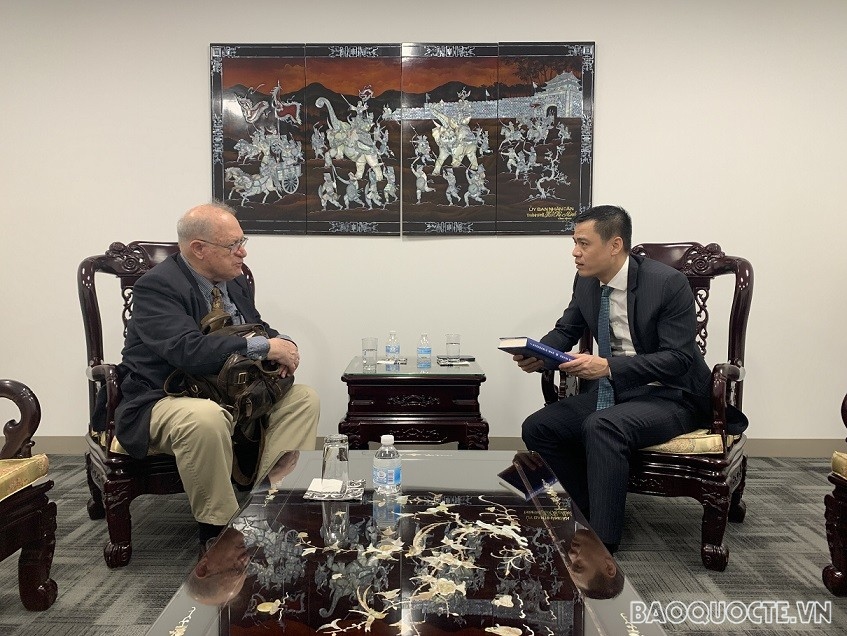
Vietnamese Ambassador Giang Meets with John McAuliff

Ambassador Dang Hoang Giang cordially received Vietnam's close friend John McAuliff

VOV.VN - Ambassador Dang Hoang Giang, Head of the Permanent Mission of Vietnam to the United Nations, on April 1 received Mr. John McAuliff, a longtime and close friend of Vietnam in New York.

Mr. John McAuliff was pleased to meet Ambassador Dang Hoang Giang back to the Mission in a new position and thanked the Ambassador for his affection for longtime American friends in Vietnam.

Mr. McAuliff discussed a number of people-to-people diplomacy activities carried out by him and the charity Fund for Reconciliation and Development in the past time as well as some expected activities in the near future. to connect and enhance exchanges between individuals and non-governmental organizations of the US and Vietnam. He expressed his support and appreciation for Vietnam's results of multilateral foreign affairs and was willing to continue participating in the upcoming activities of the Delegation.

Ambassador Dang Hoang Giang was pleased to meet Mr. John McAuliff shortly after returning to the Delegation after many years and expressed his appreciation for his interest and support for the Vietnamese Delegation to the UN and foreign activities. Vietnam's people-to-people transfer over the past half century.

The Ambassador acknowledged his enthusiastic comments on a number of outstanding international issues at the current UN forum, and hoped that he would continue to coordinate with the Vietnamese Delegation and functional agencies to strengthen understanding between the two peoples of Vietnam and the United States.

On this occasion, Ambassador Dang Hoang Giang also exchanged some ideas about activities to celebrate the 45th anniversary of Vietnam's accession to the UN (9/1977 - 9/2022) and the 50th anniversary of the Paris Agreement on peace for Vietnam. was signed (January 1973 - January 2023).

Mr. John McAuliff (born in 1942) has a close relationship with, New York, the Vietnamese Delegation to the UN since the two Vietnam Observer Delegations to the UN were established in 1975. He participated in the movement. of the American people against the war in Vietnam since the late 1960s and mobilized public opinion to support the signing of the Paris Agreement on peace in Vietnam.

He first came to Hanoi on April 30, 1975 and since then have returned many times to visit Vietnam. From 1975 up to now, he founded and operated the non-governmental organization Fund for Reconciliation and Development (FFRD) for academic exchanges and philanthropic activities to promote normalization of Vietnam - US relations; organized dozens of delegations for academic, cultural and people-to-people exchanges between the United States and Vietnam; actively lobby the US government to normalize relations with Vietnam and Cuba.


https://vov.vn/chinh-tri/dai-su-dang-hoang-giang-tiep-than-mat-nguoi-ban-than-thiet-cua-viet-nam-john-mcauliff-post934717.vov


Future Programs of VPCC


The Power of Protest:  Final Stages of Opposition to the War in Vietnam


The Vietnam Peace Commemoration Committee (VPCC) is seeking university, foundation and peace movement partners to collaborate in a national public retrospective on popular opposition to the war in Vietnam and the wider American war in Indochina. We anticipate organizing initially around the 50th anniversary of the Paris Peace Accords (January 27, 1973), which ended direct U.S. military operations in Vietnam.


Our intent is to offer an examination of the foreign policy lessons and domestic legacies of the movement against the war, with an emphasis on the 1972-73 events that led to the Accords and to a vigorous citizen lobbying campaign that facilitated an end to the war two years later. 


Memorable events occurred in this period. Nixon escalated the bombing of North Vietnamese cities and mined the country’s harbor at Haiphong. Protests were widespread, even on US military bases and ships at sea. Celebrities flew to Hanoi to oppose U.S. policy. Public opinion shifted against the war. Substantial medical assistance was sent to the North by Americans defying government regulations. Over Christmas, the B-52 bombing of Hanoi damaged Bach Mai Hospital. And against this background, the Watergate investigation began to unfold.


The VPCC was formed in 2014 by Tom Hayden, David Cortright and John McAuliff from the political, GI and faith streams of the Vietnam antiwar movement to preserve the history of that unprecedented decade-long effort. The organization has sponsored numerous in-person conferences and zoom seminars to mark the 50th anniversaries of important events that occurred during the early and middle years of that movement. We believe the time is ripe to bring a substantive nationwide analysis of the effort to stop the war, now widely regarded as a foreign policy catastrophe, to a broad audience of Americans, to the academic community, and to the national press.


We lack the institutional resources to mount such an effort alone, but believe we have much to contribute. We are the people who marched, demonstrated, resisted, boycotted, sat-in, went on strike, and were arrested. We also helped organize and lead many of the national and local antiwar organizations that sprang up during the war. We lived through the turmoil, helped shape the actions and strategies that defined the era, and can provide dramatic first-person testimony about the events that occurred. We hope to recruit celebrity activists to join us, like Jane Fonda, Joan Baez, Judy Collins, Peter Yarrow, Daniel Ellsberg, and dozens of lesser-known leaders who together can draw the press coverage that could make this retrospective a national event.


We feel an urgent need to undertake this project. Just as the passing of members of “the greatest generation” and of Holocaust survivors has already silenced most eyewitness accounts of World War II, so too are Vietnam antiwar activists becoming a diminishing resource. Most of us are now in our 70s and 80s.  We want our experiences and perspective to remain available to those who believe there are lessons to be learned from what we lived through and did.


The U.S. in the early 1970s was split in ways similar to the present. Indeed, the divisions then shaped the divisions we still live with today. Conflict over the American war in Indochina intersected with conflicts over racial justice, gendered discrepancies in power and authority, and deepening divisions in wealth. The country that emerged after the Peace Accords and Watergate was dramatically different from the Great Society that was declared a decade earlier when the U.S. war first escalated and the movement to end it was born.  


The experiences of that movement, its successes and failures, contain lessons for Americans today. Teasing them out, imagining how they can be applied, and finding ways to communicate them to young activists and scholars today and in the years to come, will be done in discussion with the partners who join us in this project. The form of the project (in-person, multi-day, multi-venue conference, teach-ins or online events), its content and organization (panels, keynotes, film screenings, slide shows, interviews) will be developed collaboratively with partnering institutions and organizations.


The attached Appendix contains a preliminary list of topics and programs VPCC has the experience and expertise to help create. Our initial focus is 1972-73, with a particular emphasis on the largely ignored, pen-ultimate stage antiwar movement. All played a role in moving the US toward an end to its war. We welcome additional topics or modifying this list in consultation with potential partners.


Each partner can choose its own level of involvement, whether developing one or two programs on suggested national topics or by emphasizing local histories.    Events can range from tens to hundreds of participants.  Our goal is that all programs are carried out with a coordinated calendar and a common national identity and are streamed and recorded for posting together.   Partners will promote each others’ initiatives by publicizing a collaborative web page.   


Postscript:  We are painfully aware as we reach out on behalf of this project that the world once again is overwhelmed with tragic images of a powerful modern military force seeking to impose its will on another nation, with horrendous cost to innocent civilians.   The US media and political leaders are embracing an outmatched resistance energized by national pride and the sentiment of Ho Chi Minh that “nothing is more precious than independence and freedom.”  This may be an especially important time for Americans to recall an era when the roles of the US and Russia were reversed.  The political context and power of repression are different, but the determination of peace activists in the US then and in Russia now are profoundly similar.


The history of VPCC and a list of our webinars can be seen here.


 If you are part of an academic institution, foundation or organization that might want to become a partner with this project, contact John McAuliff <jmcauliff@ffrd.org>

For individual involvement, please complete the survey available here or write to jmcauliff@ffrd.org  


Appendix:


Potential Program Topics for 2022-2023 Collaboration


  • The failure of US diplomacy.  The U.S. and North Vietnam reach a peace agreement in October 1972.  Kissinger’s declaration that ‘peace is at hand’ affects the election but collapses because of South Vietnam’s rejection.  The US tries to force change in Hanoi’s position with the Christmas bombing, but virtually identical provisions are signed on January 27. 1973.  Recruit: Dan Ellsberg, Greg Grandin, Amb. Dang Dinh Quy


  • The Movement.  VPCC has unique ability to bolster the historical record of the antiwar movement. We can offer eye-witness accounts of:


    • Responses to 1972 air war escalations (bombing civilians and river dikes in North Vietnam, mining Haiphong harbor). Demonstrations, celebrity trips to North Vietnam (Ramsey Clark, Jane Fonda), public opinion shifts against the war. Recruit: Jane Fonda


    • Republican and Democratic Conventions  Summer of 1972  Vietnam Veterans Against the War and other peace groups make their presence felt protesting Nixon’s nomination and celebrating McGovern’s.  Substantial focus on danger of bombing the dike system.


    • The Movement shifts from a focus on demonstrations to public education and lobbying (Indochina Peace Campaign, Indochina Resource Center), medical assistance (Medical Air for Indochina), broader church opposition. Both the Indochina Peace Campaign and Medical Aid for Indochina established offices across the country in 1972, the Indochina Mobile Education Project sponsored national tours, American Friends Service Committee redoubled its nationwide peace education work.


    • The Christmas bombing.  The Bach Mai Hospital and civilian neighborhoods are decimated when B-52s bomb Hanoi. The Pentagon attempts a cover-up, but their account is debunked by American eyewitnesses, including Joan Baez and former Nuremburg prosecutor Telford Taylor. Medical Aid for Indochina launches a US campaign to rebuild the hospital, which results in broad support (full-page ads, Leonard Bernstein concert, more). Recruit: Joan Baez.


    • Mounting pressure on Nixon to sign the Accords: Does heightened opposition force Nixon to sign the peace agreement to obtain a “decent interval” before defeat?  Project Redress organizes more celebrity protestors, public opinion shifts further after the Christmas bombing, Bach Mai Hospital Fund raises large sums, editorial opposition to the war becomes widespread, demonstrators disrupt Nixon inaugural. Recruit: Robert Jay Lifton, Noam Chomsky, Judy Collins, other Redress participants.


    • Unprecedented direct assistance to and communication with the “enemy”: Journalists and antiwar leaders are in direct touch with the North Vietnamese government and the Provisional Revolutionary Government of the south meeting in Canada, Europe and Vietnam.  The Committee of Liaison provides direct contact with POWs.  Medical Aid for Indochina, Science for Vietnam and AFSC send medical and reconstruction supplies to Hanoi.  The Paris Peace Accords and digests of the Pentagon Papers are widely distributed.  


    • IPC tour fall of 1972.  Tom Hayden and Jane Fonda lead antiwar activists and entertainers to 70 cities over 70 days prior to the presidential election, delivering skits, lectures, songs, slide shows, and appearances on local radio and TV. Recruit: Jane Fonda, Holly Near, other participants.


    • The end of the increasingly dysfunctional draft is announced on January 27, 1973 (the same date as the Paris agreement); after growing resistance, the last draftee is inducted on June 30, 1973.  What is the impact on the antiwar movement when its base is no longer at risk (and on opposition to later wars)?


    • Self-exile in Canada and Europe is chosen by some who oppose the war and the draft or remove themselves from military service.  Some remain active and work with host country opponents of the war and GI.  


  • Retrospective programs will correct the absence in the historical record of these key developments and contributions:


    • Military mutinies and their impact.  Vietnam Veterans Against the War, after throwing their combat medals back at the government, continue their dramatic actions. Sabotage occurs on US Navy ships, Air Force pilots refuse to bomb, G.I. coffee houses publish newspapers and organize soldiers against the war, antiwar POWs write to Nixon, fragging of combat officers undermines ground operations.


    • The unrecognized role of women.  Women are often under-acknowledged for their contribution to stopping the war and reducing the suffering it caused: in the political movements against the war, in the military in Vietnam, in service organizations in Indochina, and in the Vietnamese government and military.


    • Black leadership in the antiwar movement.  From individuals like Muhammad Ali to organizations like the Student Nonviolent Coordinating Committee (SNCC) and the National Black Anti-war Anti-draft union (NBAWADU), African-American activists link the call for racial justice to the call to resist the draft and oppose the U.S. war in Vietnam in the mid-1960s.  Their actions profoundly influence the course of the war. How did African-American antiwar activism manifest in the 1970s? Recruit: Cleveland Sellers, Robyn Spencer


    • Hispanic and Asian Communities and Vietnamese studying in the US play a little known but significant part in the antiwar movement


·         The Reaction: Watergate links to fear of the antiwar movement.  Publication of the public opinion shaping Pentagon Papers leads Nixon’s advisors to create the Plumbers who break into the office of Daniel Ellsberg’s psychiatrist, ultimately leading to dismissal of the case against Ellsberg. Key figures in the Plumbers direct the Watergate break-in, resulting in the famed hearings and resignation of Nixon and his distraction from continuing the war.


·         COINTELPRO.  Major resistance is planned (and thwarted) to undermine Nixon’s re-election, including a John Lennon concert tour. Nixon moves the convention from San Diego to Miami, resistance mounts, COINTELPRO (including plans for detention camps) is revealed, and Nixon becomes obsessed with the antiwar movement.


·         The hidden wars in Laos and Cambodia. Illegal U.S. troop incursions and massive (often secret) bombing campaigns (which made Laos the most heavily bombed country per capita in history) wrought extensive and lasting physical damage in both countries, caused massive dislocation of the population and an estimated 450,000 casualties. U.S. support of the coup that ousted Prince Sihanouk set the stage for the rise of the Khmer Rouge in Cambodia and for the genocide that followed.


·         Films and slide shows educate and motivate activists and a wider public  Films from Newsreel circulate by peace organization and are supplemented by sponsored media from NARMIC and the Indochina Peace Campaign.  Mainstream media reach a wider public with “Born on the 4th of July”, “Hearts and Minds” and implicitly M*A*S*H.


Potential Program Topics for 2023-2025 Collaboration


·         Post-Accords lobbying effort.  The Coalition to Stop Funding the War is founded in January 1973 to bring together the secular and religious peace movements to press Congress to end all US military activities with legislation adopted in August 1973 and to pass the War Powers Act in November.


·         End Game  Military appropriations for South Vietnam are significantly reduced three times over the next two years, leading to the end of the war in April 1975. Antiwar Members of Congress (Drinan, Dellums, Abzug, Holtzman) play a significant role. Recruit: Elizabeth Holtzman.


·         Direct engagement of US peace activists and in-country Quaker and Mennonite staff with Third Force counterparts in South Vietnam whose participation was specified in the political provisions of the Peace Accords but brutally repressed by the Thieu government 


·         Truth and reconciliation.  Failure to appoint an official commission to investigate reasons for and character of US intervention in Indochina and specific war crimes (saturation bombing targeting civilians, forced relocation, free-fire zones, assassination teams, atrocities by rogue units) in Vietnam, Laos and Cambodia? Agent Orange, landmines and unexploded ordnance problems are ongoing, and the Peace Accords stipulate US aid to heal the wounds of war. How does a country’s memory of war affect its collective conscience and its proclivity to wage new wars? What might a T & R Commission look like, and what might its impact be? Recruit Robert Jay Lifton, Noam Chomsky, Charles Bailey, Susan Hammond.


·         Interpretations of the end of the war  Kerry Kennedy’s film vs. eyewitness accounts from an antiwar perspective


·         The Postwar War I refugees and reeducation


·         The Postwar War II frustrated efforts at early normalization, third Indochina war, failure to address Khmer Rouge extremism by peace activists and US government, Cambodian civil war and Paris Agreement


·         Planting seeds for reconciliation  Friendshipment, AFSC and MCC aid to reunified Vietnam, ten NGO conferences address post war legacies and humanitarian/development aid programs